Vending
Fastenal makes vending part of its industrial supply strategy
Fastenal combines industrial vending, monitored inventory bins and replenishment services to help businesses control supply use and keep operations running. Sales through its FASTBin and FASTVend systems reached $827.2 million in the third quarter, showing the scale of its digitally managed supply business.
November 6, 2026 by Richard Slawsky — Editor, Connect Media
 ChatGPT
 Grok
 Perplexity
 Claude
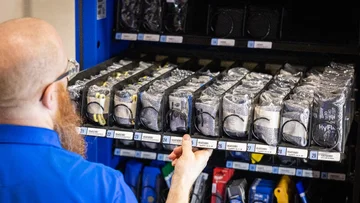
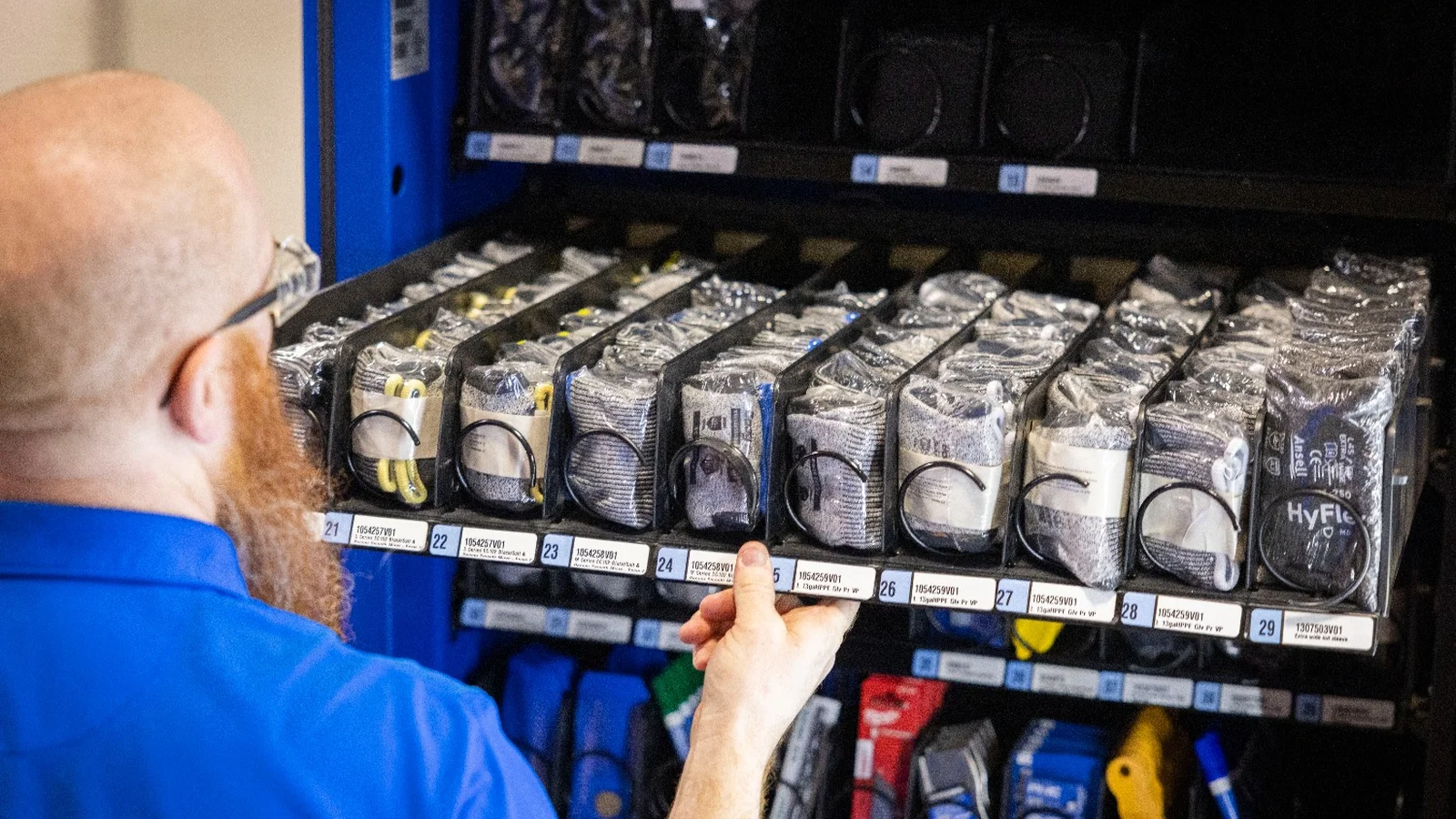
For Fastenal, a vending machine dispensing safety gloves or cutting tools is part of a larger business: managing the supplies customers need to keep their operations running.
Sales through the Minnesota-based distributor's FASTBin and FASTVend systems reached $827.2 million in the third quarter of 2026, up 17.6% from a year earlier. The combined figure covers electronically monitored inventory bins as well as vending equipment.
The equipment gives employees access to gloves, safety glasses, drill bits and other supplies while recording who takes each item and when. Customers can use that information to control consumption, allocate expenses and plan replenishment.
"The value of industrial vending is much broader than putting product in a machine," Jeremy Johnson, general manager with Fastenal, said in an email interview. "It brings inventory closer to the point of use while creating visibility into who is using products, where they are being used, and at what rate."
That combination of product access and usage data makes vending part of an ongoing supply service. For customers, the equipment's value depends on how well it supports their operations; for Fastenal, it creates another point of connection with the businesses it supplies.
From fastener store to factory floor
Fastenal began in 1967, when Bob Kierlin and four partners opened a small fastener store in Winona, Minnesota, with about $30,000, according to the company's history.
Kierlin's original idea involved selling fasteners through vending machines. Fastenal initially developed through a conventional sales and branch model, building a business around keeping industrial supplies close to customers.
Placing inventory management equipment inside customer facilities extended that approach. Vending added controlled access and transaction records to the convenience of nearby stock.
Fastenal's automated inventory operations are organized under its Fastenal Managed Inventory, or FMI, technology platform.
FMI includes three primary offerings. FASTStock uses digital scanning to support replenishment of supplies stored on shelves, in cabinets and in other conventional locations. FASTBin uses technologies including radio-frequency identification, infrared sensors and scales to monitor inventory levels. FASTVend dispenses products and records their use.
Employees can access supplies through machines configured with purchasing and usage controls. Depending on the installation, operators can restrict access to particular products, establish dispensing limits and associate transactions with employees, departments or job numbers.
Unlike traditional consumer vending, the transaction does not necessarily involve a customer making an individual payment. Instead, the equipment functions as a controlled distribution point within an employer's inventory system.
"FASTVend has continued to evolve from a dispensing solution into part of a broader digital inventory-management environment," Johnson said. "Capabilities include user identification and access controls, transaction-level data capture, inventory visibility, and replenishment workflows."
Connecting those systems gives customers a way to monitor supplies across vending machines, storerooms and inventory bins. Johnson said analytics and artificial intelligence could help identify consumption patterns and guide inventory decisions.
"Analytics and AI can add value by turning the data we capture into better recommendations and decisions, while keeping the operating model practical for the customer rather than adding unnecessary complexity," he said.
The scale behind the strategy
Fastenal reported total third-quarter revenue of $2.46 billion, up 15.5% from a year earlier, and net income of $401.6 million, up 19.7%, in financial results released Oct. 14.
Including FASTStock, sales through the broader FMI platform totaled about $1.12 billion for the quarter. For the first nine months of 2026, FMI sales reached about $3.2 billion, up 15.8% from a year earlier.
Those totals measure products sold through digitally managed inventory systems, rather than revenue exclusively from vending machines or fees for the technology itself.
Fastenal also cautioned in its earnings release that some FMI sales growth reflects products moving from conventional stocking locations into digital systems. Growth in that category therefore does not necessarily represent entirely new customer demand.
At the end of September, Fastenal reported 143,878 weighted FASTBin and FASTVend installations, up 7.4% from a year earlier. The measure uses standardized machine equivalent units based on expected device output; it is not a count of individual vending machines.
The company signed 7,484 weighted FASTBin and FASTVend devices during the quarter and set a full-year goal of 27,000 to 29,000 machine equivalent units.
What customers gain
For a factory or facilities department, the practical question is whether managed inventory reduces the time and expense of obtaining supplies. Equipment near workstations can shorten trips to supply rooms, while usage records can help managers identify unusual consumption and adjust orders.
Johnson pointed to the University of South Carolina as an example of Fastenal's broader inventory management services. Leroy Sims, assistant director of facilities custodial services at the university, said Fastenal's inventory management approach has reduced the time employees spend obtaining cleaning supplies.
"We're not spending our time driving or stocking or searching for any of those things," Sims said in a statement provided by Fastenal. "Having uniform products across this campus means we can ensure that our cleaning standards are being upheld, because we know what our team is cleaning with and how they're cleaning."
The technology also provides information about product usage, cleaning costs and changes in building traffic, he said.
Connecting the customer relationship
Industrial vending places different demands on an operator than a machine selling snacks or beverages. A customer may judge success by access to supplies, inventory accuracy and consumption control. The supplier must account for equipment, software, replenishment and maintenance.
"Fastenal makes the technology available as part of an inventory-management solution when the application supports a sustainable service model," Johnson said.
The company evaluates product demand, transaction volume, inventory requirements, service needs and potential customer benefits before determining whether a particular application is appropriate.
"The goal is a model that improves the customer's supply chain while being economically sustainable for both parties," Johnson said.
Equipment configuration also depends on the facility. A production operation that consumes large quantities of gloves and cutting tools may require a different setup than a maintenance department seeking occasional access to specialized parts.
"Industrial vending remains an important part of our FMI strategy because it helps us manage indirect materials at the point of use while creating useful consumption data and tighter integration with customer operations," Johnson said.
Fastenal's strategy is to link dispensing with storerooms, monitored bins, ordering and other inventory functions, giving customers a more complete view of their supplies.
"We see the larger opportunity as connecting vending with our broader inventory-management capabilities rather than treating each technology as a standalone product," Johnson said.
The model gives vending operators a useful question to consider: Can an equipment placement support an ongoing service relationship that solves a customer's inventory problem?
For Fastenal, that relationship extends from the moment an employee takes a pair of gloves to the next replenishment order. The machine provides access; the continuing business is managing the supply.
About Richard Slawsky
In addition to writing, Slawsky serves as an adjunct professor of Communication at the University of Louisville and other local colleges. He holds both a Bachelor’s and a Master’s degree in Communication from the University of Louisville and is a member of Mensa and the National Communication Association.
Related Media
Subscribe
Get the latest news and resources from Vending Times.
Recent Posts