Vending
Modern vending, where smart investment meets smart design
In today’s vending landscape, success depends on the alignment of smart investment and well-designed technology, a winning combination for strong performance and sustainable growth.
April 15, 2026 by Dale Laszig — Founder, DSL Direct LLC
 ChatGPT
 Grok
Grok Perplexity
 Claude
Vending can be an attractive entry point into business ownership. The industry has long been viewed as a simple, low-effort side business, but operators are finding there's far more to success than buying, placing and restocking machines.
Unattended technology has become more nuanced and complex. Consumers have broader product selections and more ways to pay, while operators are deploying smarter, hyper-connected machines. As expectations evolve, owners, operators and newcomers can find abundant opportunities at the intersection of smart investment decisions and thoughtful machine design.
Easy entry, scalable growth
Phil Nelson, a multi-unit franchise owner and consultant who has advised individuals on franchise investments for more than a decade, sees a strong fit between vending and entrepreneurship.
"It is a simple business model that can be run from a home office with minimal overhead," Nelson said. "The 'employees' are the machines and they do not call out sick or take vacations."
This simplicity, combined with a route-based structure, gives operators flexibility to run a business full time, part time or as a supplemental income stream. Still, opportunity alone doesn't guarantee success.
Nelson emphasized execution is what separates high-performing operators from the rest. Training, support and a clear understanding of what top franchisees do differently are critical. He often advises prospective buyers to speak with top, average and low-performing operators to understand what is possible, what is typical and what pitfalls to avoid.
High-margin products, hard-working machines
Nelson observed that shifting consumer preferences are opening new avenues for growth. Demand for healthier snacks in locations such as fitness centers, hotels and dealerships is creating opportunities for higher-margin products and differentiation in crowded markets.
As modern vending machines continue to evolve from simple dispensers to customer-facing digital touch points, their design can influence everything from transaction volume to customer satisfaction. Smart devices with advanced telemetry allow operators to monitor inventory in real time, streamline restocking and maintain fresher product assortments. These capabilities reduce operational friction, enabling operators to focus on optimizing product mix and location performance rather than reacting to inventory shortages.
In vending, high-tech machines consistently outperform low-tech alternatives. Consumers increasingly expect to insert or tap cards and digital wallets, and machines that accommodate all payment types are better positioned to capture more transactions than cash-only models.
"Consumers demand convenience," Nelson said, adding people are generally willing to spend more when electronic payment options are available.
Design that drives performance
As operators look to align technology with performance, manufacturers are rethinking how machines are designed and deployed. Verifone, a global payments technology provider, showcased its Victa product line in January 2026 at NRF 2026: Retail's Big Show. The platform included unattended and mobile models engineered for kiosks, vending, parking, public transit and similarly demanding environments.
Also on display was Verifone Touch, a customer-facing kiosk available with 22-inch and 27-inch screens. Designed to engage customers with dynamic content delivery, the kiosk's large-format displays complement the company's Victa family of devices.
Veronica Kent, director of product marketing at Verifone, pointed to several core design pillars that guide the company's hardware and software from prototype through certification and field use.
Accessibility
"Accessibility improves customer satisfaction, loyalty and merchant confidence, helping merchants focus on their business knowing payment experiences are inclusive," Kent said. "We collaborate with organizations such as the Royal National Institute of Blind People to ensure real-world usability and ongoing validation."
"Accessibility isn't an add-on for us," she added, noting that unattended terminals incorporate tactile cues, high-contrast interfaces and audio guidance to support a wide range of users. These capabilities continue to evolve alongside changing accessibility standards across devices, applications and cloud-based services.
Sustainability
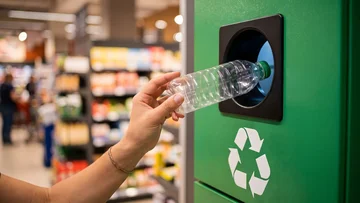
Kent positioned sustainability as a force that powers the industry forward, with Verifone's approach spanning the entire device lifecycle. Sustainable design principles guide the creation of durable, repairable and energy-efficient hardware.
"We view sustainability as essential to modern commerce," she said, noting user-replaceable batteries extend product lifespan and reduce waste, while reduced-plastic packaging aligns with the company's environmental standards.
"Our circular hardware strategy includes refurbished programs, end-of-life disassembly, and material recycling and recovery," she added. Software-driven innovations such as digital receipts and remote updates further reduce waste while extending device lifecycles.
Futureproof, backward compatible
As vending continues to move toward a more connected, data-driven model, machines are becoming smarter, more responsive and more aligned with consumer expectations around convenience, personalization and health-conscious choices. Even legacy equipment has proven adaptable, with upgrades that extend usability and keep machines competitive.
For franchise buyers and operators, success begins with choosing the right business model and machine and executing a strong business plan. Equally important are evaluating how machines are designed, how they accept payments and how they support customers and operators.
In today's vending landscape, success depends on the alignment of smart investment and well-designed technology, a winning combination for strong performance and sustainable growth.
About Dale Laszig

Related Media
Subscribe
Get the latest news and resources from Vending Times.
Recent Posts