Vending
High Gas Prices Are Making Vending Route Efficiency More Important Than Ever
High fuel prices are putting new pressure on vending route profitability. This article explores how smarter scheduling, accurate inventory, pre-kitting, par levels, and machine-level data can help operators reduce unnecessary stops, cut miles, and run more efficient routes.
September 28, 2026
 ChatGPT
 Grok
Grok Perplexity
 Claude
For vending operators, the cost of an unnecessary service call just went up.
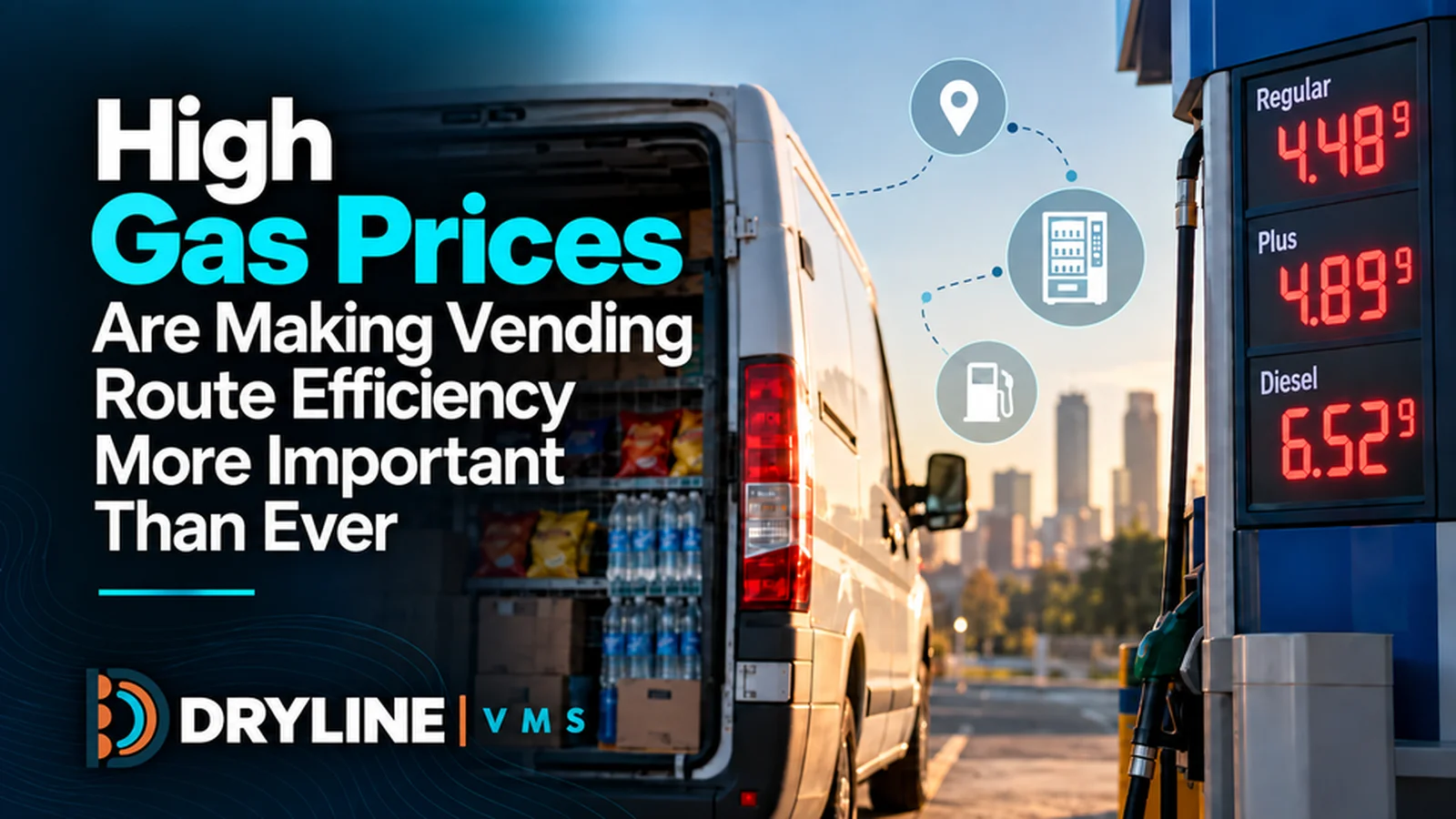
As of September 28th, the national average for regular gasoline is roughly $4.48 per gallon. AAA says that is the highest national average ever recorded for this time of year, with September on track to set a new monthly record. Diesel costs have been even more dramatic, reaching a record national average above $6.52 per gallon earlier this month.
For an industry built around tight margins and the trucks needed to keep them in operation, those numbers matter. Every machine in operation requires fuel, driver time, vehicle maintenance and depreciation, and the cost of inventory that keeps rising right along with the cost of gas.
This requires operators to ask themselves an increasingly important question: Does every machine on today's route actually need to be visited?
For many vending operators, routes have traditionally been built around fixed schedules. A driver may visit a particular group of accounts every Monday, another group on Tuesday, and so on. Routes get designed for a variety of different reasons, where they are located, gut feeling of how often they need to be serviced, contractual requirements, you name it. Some of those machines genuinely need service, others may still have plenty of product, but the truck drives there either way. At today's fuel prices, those unnecessary miles are becoming much harder to ignore.
The goal of a better vending router management is not simply to drive faster or squeeze more stops into a day. It is to drive fewer unnecessary miles while keeping the right products available in the machines that actually need service.
The Most Efficient Service Call May Be the One You Don't Make
Consider a hypothetical operator with 100 vending machines. Traditionally, each of these machines may be visited once per week. Now suppose inventory and sales data show that 20 of those machines can safely wait several more days before service. If avoiding those visits eliminates an average of eight miles per stop, how does that impact your bottom line?
20 stops x 8 miles = 160 miles per week
Over a year, that becomes:
160 miles x 52 weeks = 8,320 miles
For a route vehicle averaging 12 miles per gallon, that is roughly 693 gallons at fuel. At $4.48 per gallon, the operator would avoid more than $3,100 in fuel costs alone. This basic equation doesn't account for driver wages, oil changes, maintenance, vehicle depreciation, and hours that could have been spent servicing higher-value locations. Your numbers may be different, but the principle remains the same. Every unnecessary stop has a cost.
Move Beyond Fixed-Service Routes
There is nothing inherently wrong with assigning machines a normal service schedule. A defined structure brings organization to an operator, but the problem occurs when the calendar becomes the primary reason a machine gets serviced. A high-volume machine in a manufacturing facility may need attention several times per week. A machine in a small office may be able to go ten days or longer. Treating them identically creates unnecessary service calls, a more efficient model combines a normal service cadence with actual machine conditions.
Operators need to consider factors such as:
- Current inventory
- Recent sales
- Product sell-through
- Sold-out or low selections
- Time since last service
- Machine activity
- Failed Vends or equipment issues
- Distance from other scheduled stops
The vending industry has been working toward this model for years. Industry insiders have documented how operators have used product-level data, pre-kitting and dynamic scheduling to reduce route requirements and improve driver productivity. One industry analysis reported significant efficiency gains after operators moved away from fixed schedules and toward service based on actual machine needs.
The question changes from "Which machines do we service on Tuesday?" to "Which machines actually need us on Tuesday?"
Accurate Inventory Makes Smarter Routing Possible
An operator cannot confidently postpone a service visit without trusting the inventory information coming from the machine. That makes accurate inventory one of the foundations of efficient route management. It also means looking deeper than total machine inventory, a machine may still be 60 percent full while its three highest-selling products are completely sold out.
An operator should ideally understand:
- Which product is loaded
- Selection number
- Capacity
- Current quantity
- Selling price
- Product cost
- Sales velocity
- Target inventory
- Expected time until sellout
The more accurately an operator can track inventory and sales at the selection level, the more confidently service intervals can be adjusted. Instead of relying solely on historical schedules, operators can use recent sales velocity and remaining inventory to estimate when a machine is likely to require its next visit. That is what allows route optimization to move beyond simply mapping a shorter drive. The first opportunity to save miles happens when the operator determines whether the stop needs to happen at all.
Use Par Levels Instead of Simply Filling Everything
Another opportunity is to rethink what "full" means. If a selection holds 12 products but normally sells three between visits, filling it to 12 every time may tie up unnecessary inventory. Meanwhile, another selection may routinely sell out before the next service. Par levels help operators adjust inventory according to actual demand.
The basic process becomes:
Sales history → sales velocity → par level → restock quantity → next service requirement
Rather than asking: "How many products will fit?" the better question becomes "How many are likely to sell before we return?"
Accurate par levels can help an operator extend service intervals on slower machines while still maintaining adequate product availability. They can also help identify the opposite problem; if a high-volume selection consistently approaches empty before the next visit, the operator can increase its par level, adjust the product mix, increase capacity where possible or shorten that particular machine's service interval. The point is not simply to visit less often, it is to make the right number of visits for each machine.
Keep Planograms Accurate
Inventory forecasts are only useful if the system knows what is actually inside the machine. If a vending management system thinks selection A4 contains chips but the route driver replaced them with cookies and never recorded the change, inventory forecasts and pre-kitting requirements become unreliable. That may be manageable when the owner operates ten machines and knows each one personally. It becomes much more difficult at 100, 500, or 1,000 machines.
An accurate digital planogram should identify information such as:
- Product
- Selection
- Capacity
- Price
- Current inventory
- Targe inventory
When products change, the planogram needs to change with them. Keeping that information current creates a reliable digital representation of what should physically exist inside the machine. That accuracy becomes increasingly important as inventory management, pre-kitting, forecasting and route planning become interconnected. Bad planogram data creates bad inventory data, bad inventory creates bad restock recommendations, and bad restock recommendations eventually create unnecessary service calls.
Pre-Kit Before the Truck Leaves
Route efficiency also depends on what happens before the driver starts the engine. In a traditional route model, the driver may leave the warehouse carrying a large assortment of products that could potentially be needed that day. At each location, the driver determines what sold, retrieves the necessary products from the truck, restocks the machine and carries the remaining inventory to the next stop. That process works, but it creates unnecessary product handling and can increase the amount of time spent at each location. Pre-kitting moves much of that decision-making into the warehouse. When machine inventory is accurate, products can be picked and organzied before the route begins, allowing the driver to arrive with a much clearer picture of what each machine is expected to need.
The workflow becomes:
Machine inventory → expected demand → required restock → warehouse pick → machine-specific prekit
Instead of carrying a mobile warehouse full of products the driver might need, the truck can increasingly carry products the scheduled machines are actually expected to need. That can reduce product handling, shorten service time and make truck inventory easier to manage. There is another important connection to fuel efficiency. When an operator knows that each machine needs before the route begins, there is less risk of discovering halfway through the day that the truck does not have enough of a particular product and requiring an additional trip. Pre-kitting isn't just a warehouse efficiency tool, its part of route planning.
Optimize for Both Need and Geography
Knowing which machines require service is only half of route optimization, the next question is how to reach them efficiently. Imagine that six machines require attention: Three are clustered in one part of town, two are near each other in another area, but the sixth machine is significantly farther away. The distant machine may technically qualify for service, but perhaps data shows it still has four days before an important selection is expected to sell out. If another route will already be near that location in two days, servicing it today may make little economic sense. That is why effective route planning should consider both urgency and geography.
Factors can include:
- Estimated days to sellout
- Inventory levels
- Sales volume
- Geographic proximity
- Location access hours
- Machine condition
- Driver capacity
- Product requirements
When fuel is expensive, unnecessary distance between stops becomes even more significant. The goal is not simply fewer stops, it is few unnecessary miles between the stops that actually matter.
Give Drivers Better Information in the Field
Even a well-planned route can become inefficient if the driver does not have accurate information once they leave the warehouse. Drivers should be able to see what was expected at the machine and quickly record what actually happened.
This can including things like:
- Machine planogram
- Products by selection
- Expected inventory
- Restock quantities
- Assigned Route
- Previous service activity
The information they collect during their visits should then improve the next route. A modern service cycle should increasingly look like:
Plan → pick → route → restock → recount → synchronize → plan again
Each service visit improves the data available for the next decision, this creates a feedback loop instead of a series of disconnected service calls. If actual inventory differs from what was expected, that information becomes useful.
Perhaps the machines's product mapping is wrong?
Perhaps a selection was changed without being recorded?
Perhaps sales activity and physical inventory do not match?
The driver should not only be filling the machine, the visit should also improve the information used to operate it.
Manage Exceptions Instead of Checking Everything
Inventory is not the only thing that puts trucks on the road, equipment problems create service calls too.
A machine stops communicating
A payment reader goes offline.
Several failed vends occur.
A normally active machine suddenly stops producing transactions.
Without remote visibility, the first indication of a problem may come from a customer complaint or from the route driver several days later. A more scaleable model is to manage exceptions, instead of constantly checking every machine, operators can focus their attention on machines displaying conditions outsider their normal operating pattern. That may mean a machine has stopped communicating, a high-volume product approaching sellout, or an unusual number of failed vends. Those exceptions can then become part of the route-planning decisions. Maybe an alert creates a new stop, maybe it increases the priority of a stop already planned, or perhaps the information allows the operator to diagnose a problem before needing to send a vehicle out to it at all. The objective is not necessarily to eliminate service calls, it's to make them more intentional.
Measure Route Efficiency, Not Just Machine Sales
Revenue is important, but it does not tell the entire story. A machine producing $500 per month is not automatically more profitable that one producing $400. What if the $500 machine requires twice as many service visits? What if it sits 30 miles from the rest of the route? What iif the $400 machine is located beside three other accounts and only needs service every ten days?
Useful operational metrics can include:
- Revenue per machine
- Revenue per service visit
- Vends per machine
- Units restocked per visit
- Stockout frequency
- Days between service
- Miles driven
- Stops per route hour
- Failed vend rate
- Machine downtime
- Product waste
- Gross margin by location
Operators can take the analysis even further by looking at revenue or gross profit relative to the resources required to service an account. The question isn't simply: "How much does this machine sell?" It is: "How efficiently can we generate those sales?" The distinction becomes increasingly more important as the cost of everything goes up (Labor, vehicles, inventory, fuel, etc).
Turning Machine Data Into Route Decisions
This is also one of the problems we have been focused on when developing DrylineVMS. Having more information on a dashboard is not the objective by itself, the value comes from turning machine information into operational decisions.
Which machines need service?
Which ones can safely wait?
What products should the driver take?
What should be pre-kitted before the route starts?
Which selections are approaching sellout?
Which stops should be grouped together?
Which machines require immediate attention?
DrylineVMS brings together machine planograms, product and inventory management, DEX data, transaction information and field operations. At the machine level, operators an maintain visual planograms and inventory by selection. In the field, route personnel can perform restocks and recounts and update the information that will be used to plan future service.
For operators looking to optimize larger routes, DrylineVMS Pro extends that workflow with driver route management, service visits, central warehouse inventory, pre-kitting, sales velocity, forecasting, par-level management, days-to-sellout visibility, exception workflows, and machine alerts.
The goal is to connect the process from the warehouse to the vending machine and back again. It's not simply to collect more data, but to use the data to reduce unnecessary work.
High Fuel Prices Expose Inefficiency That Was Alredy There
Gas prices will eventually change, the underlying opportunity will not. Whether gas costs $4.48, $3.50, or $2.50 per gallon, driving to a vending machine that did not need service still costs money. High fuel prices simply make those inefficiencies easier to see. As vending technology gives operators better machine-level information, route management can increasingly move away from servicing machines primarily because they appear on a calendar.
Instead of Visit every machine, vist the machines that need service.
Instead of Carrying everything a route might need, pre-kit what today's machines are expected to need.
Instead of Filling every selection to capacity, use sales velocity and par levels.
Instead of Discovering problems on the next scheduled visit, identify exceptions before building the route.
And instead of asking What's on todays route? ask "What is the most productive use of today's truck miles?
Because in vending, the cheapest mile isn't the one you drive more efficiently.
It's the mile you didn't need to drive at all!
Learn More About DrylineVMS
DrylineVMS was built to help vending operators turn machine data into better operational decisions. From visual planograms and inventory management to route planning, pre-kitting, forecasting, par levels, DEX, and machine monitoring, DrylineVMS brings the tools needed to manage a modern vending operation into one platform.
Learn more at DrylineVMS.com or schedule a walkthrough to see how Dryline can help make your routes more efficient.
About the Author
Austin Kunz is the founder of Cactus Wash Systems and DrylineVMS, where he focuses on developing software, payment, and automation solutions for unattended retail businesses. His work centers on connecting machine data, payments, inventory, and field operations to help operators manage unattended businesses more efficiently.
Learn more about DrylineVMS at DrylineVMS.com and Cactus Wash Systems at CactusWashSystems.com.
Contact:
sales@drylinevms.com
844-723-9732
Included In This Story

DrylineVMS
Run Unattended. Stay in Control.
Dryline VMS is vending management software for unattended retail operators. It shows each machine as its real front with product, price, and fill level per slot; builds planograms by scanning barcodes; reconciles DEX and settlement; and reports sales tied to the actual product sold. It imports and exports NAMA VDI 2.0.
Related Media
Featured Vendor

Give your kiosks the best in managed connectivity and placement flexibility with powerful 4G LTE
Subscribe
Get the latest news and resources from Vending Times.