Vending
How to Win Vending Locations and Price for Profit: A Playbook for New Operators
A practical playbook for new vending operators from Dryline VMS: how to find and win locations, what goes in a location agreement, how to choose a commission, and how to stock, lay out, source and price every machine, with industry data from NAMA, the U.S. Census Bureau, the BLS and the FTC.
November 11, 2026
 ChatGPT
 Grok
 Perplexity
 Claude
Most new vending businesses are won or lost before the first machine is stocked. The location you pick, the deal you sign, the commission you agree to and the prices you set decide what each machine earns long after the install.
At Dryline VMS we build vending management software and the Rain Pay card reader for operators. This guide covers the business side of starting out: finding and winning locations, the location agreement, commission strategy, stocking, planograms, where to buy product and how to price it. Every vending term is explained the first time it comes up. For permits, sales tax, choosing machines and taking cards, start with our earlier guide, How to Start a Vending Business: The Complete Guide for New Operators.
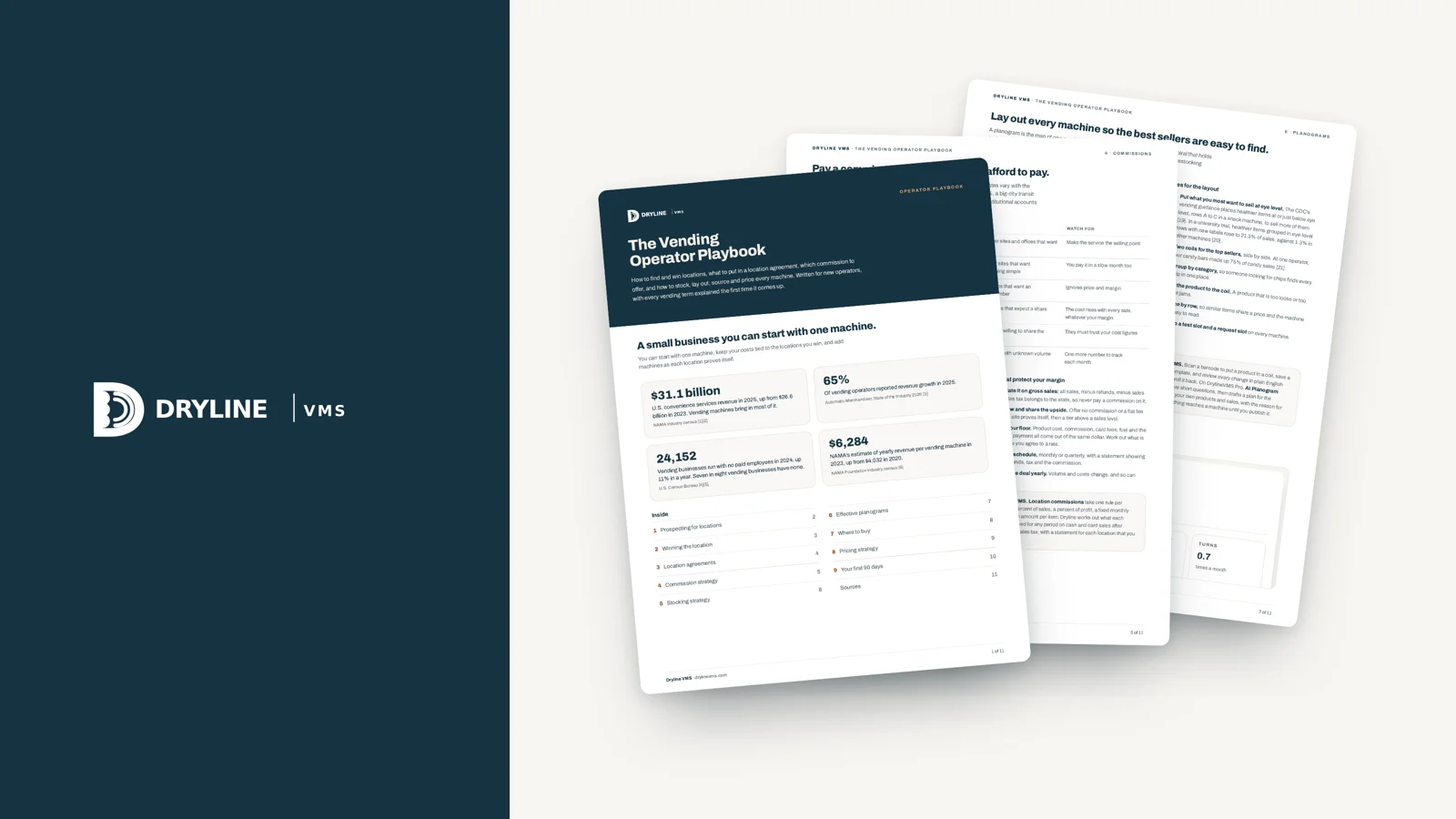
Everything here is also in a free, printable workbook with a site scorecard, a location agreement checklist and a pricing worksheet: The Vending Operator Playbook (PDF).
Why is vending a good business to start?
Vending is a large industry that is still growing, and it is built for small operators.
- A $31.1 billion industry. U.S. convenience services revenue, most of it from vending machines, reached an estimated $31.1 billion in 2025, up from $26.6 billion in 2023 (NAMA).
- Most operators are growing. More than 65% of operators reported revenue growth in 2025 (Automatic Merchandiser, State of the Industry 2026).
- Built for small operators. 24,152 vending businesses ran with no paid employees in 2024, up 11% in a year, and about seven in eight vending businesses have no employees at all (U.S. Census Bureau).
- Shoppers keep moving to self-service. The Bureau of Labor Statistics projects cashier jobs to decline 6% from 2025 to 2035, citing self-service checkout (BLS).
- Break rooms are still full. 70% of employed Americans did some or all of their work at their workplace in 2025 (BLS American Time Use Survey).
A machine also works the hours you do not: nights, weekends and the lunch rush you are not there for. You can start with one machine, keep your costs tied to the locations you win, and add machines as each location proves itself.
How do you find good vending machine locations?
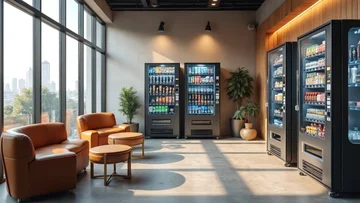
In vending, a location is the business that hosts your machine. The best first locations have a captive audience: people who spend hours there, at times when a store is closed or too far away to bother.
- Offices and break rooms: the same people every workday, many with short breaks.
- Factories, warehouses and distribution centers: long shifts, nights and weekends.
- Gyms: drinks and protein after a workout.
- Apartment buildings, dorms and hotels: residents and guests after nearby stores close.
- Auto shops, tire stores and laundromats: customers stuck waiting.
- Schools, hospitals and public buildings: steady traffic, though vending there is often put out to bid, with nutrition rules to follow.
What makes a location worth pitching?
- People: enough people on site every day, staying long enough to get hungry or thirsty. A common rule of thumb is more than 50 people on site (Vending Times), and manufacturing sites are the most common vending locations, ahead of offices (NAMA Foundation).
- Hours: long opening hours, and access to the machine around the clock if you can get it.
- No easy alternative: no store, cafeteria or other machine a short walk away.
- Space, power and signal: a dedicated outlet, a level floor, doorways the machine fits through, and cellular coverage or Wi-Fi for the card reader.
- A decision maker who wants it: a manager who can say yes and sees the machine as a perk.
Score every prospect on the same points so you pitch the best sites first. The playbook includes a weighted site scorecard for this. Then keep a lead list with each business, its contact, the date of each visit, its score and the next step.
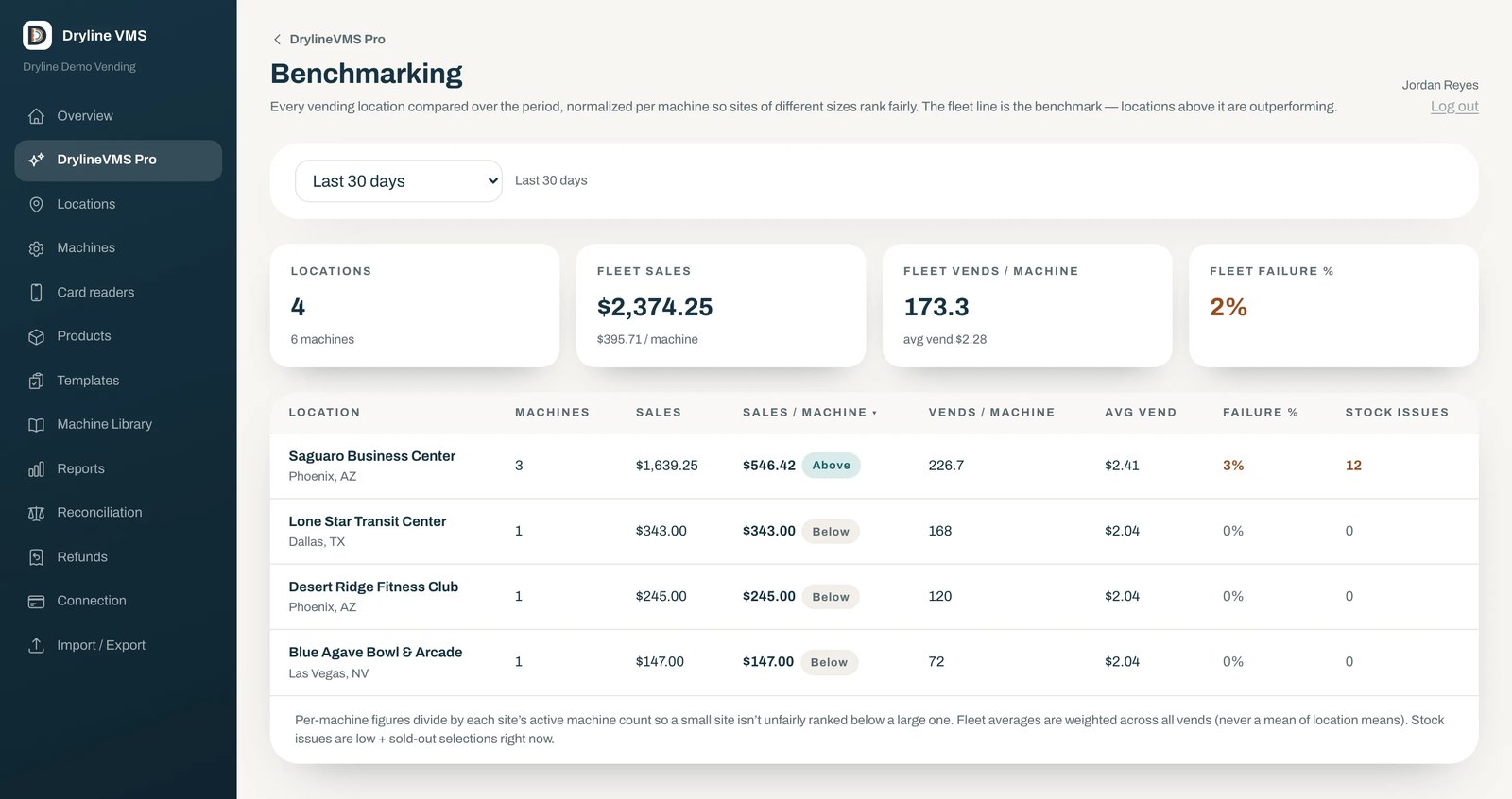
Benchmarking in DrylineVMS Pro ranks each location by sales per machine against the fleet average.
In Dryline VMS: once a location is live, Reports show its sales, vends and average sale. On DrylineVMS Pro, Dryline’s upgraded plan, Benchmarking compares every location per machine, so a small site is not ranked below a large one just for its size, and shows which locations earn their spot.
How do you win a location?
Ask for the person who decides: an office or facilities manager, a property manager, the owner of a small business, or HR when the machine is a staff perk. Leave a one-page proposal behind, so the answer does not depend on someone remembering your visit. It should cover:
- The machine, with a photo of one you already run.
- What you will stock, with room for their requests and healthier choices.
- How often you visit and how fast you fix a problem.
- How people pay: cards, phones and watches as well as cash.
- How refunds work, through a phone number or QR code on the machine.
- What it costs them: nothing beyond the power outlet. You deliver, stock, service and insure the machine.
- Commission, if you offer one, and your certificate of insurance and a reference.
Then ask for a trial: “Let’s put one in for 90 days and look at the numbers together.” When you hear “we already have a vendor,” ask what they would change. Empty coils, no card reader and slow refunds are common openings. Follow up within a week, then monthly.
Before you pay anyone for locations
Some companies sell machines bundled with locations, or charge to find them. Under the Federal Trade Commission’s Business Opportunity Rule, the seller must give you a one-page disclosure document at least seven days before you sign or pay, with written proof behind any earnings claim (FTC). One vending business opportunity scheme that used locators cost buyers $60 million between 2005 and 2010 (Vending Market Watch). Locators can charge hundreds of dollars for cold calls with no guarantee (Vending Times), and one operator told Vending Times that only one or two of every ten locators delivered a satisfactory site. Visit each location and meet its manager before you pay anyone.
More in How to find vending machine locations and win them.
What goes in a vending location agreement?
A location agreement, also called a placement agreement, sets out who does what, who is paid what, and how either side ends it. Managers change jobs and buildings change hands, and the agreement keeps your machine and your terms in place when they do. State the term in months from the day the machine goes in (Vending Market Watch). One model contract published in Vending Market Watch runs three years, renews in two-year periods, and gives the operator 60 days to fix a problem before the location can end it. Cover:
- Placement and term: who signs, the address, exactly where the machine stands, how long the agreement runs and whether it renews by itself.
- Exclusivity: you are the only vending provider on site, or for the categories you sell.
- Commission: the model and rate, what it is calculated on, when it is paid and the statement that comes with it.
- Service and refunds: how often you visit, how quickly you respond, and that refunds come from you.
- Power, space and access: the location supplies the outlet and power, and you get access to service the machine.
- Insurance, liability and damage: your general liability coverage, who is responsible for what, and who pays if the machine is damaged or broken into.
- Ownership, prices and products: the machine and everything in it stay yours, and you set prices and the product mix.
- Ending it: the notice each side gives, how long you have to remove the machine, and the final commission.
Have a local attorney turn this list into your standard agreement once. After that, only the location details and the commission change from site to site.
How much commission should you pay a location?
A commission is the share you pay a location for hosting your machine. Rates vary with the location. In one industry survey, apartment buildings were paid 10% to 15%, a big-city transit system 28%, and a private business nothing at all, and government and institutional accounts weighed commission more heavily than private businesses did (Vending Market Watch). The models:
- No commission: the location gets the amenity and your service. Common at smaller sites and offices that want a perk.
- Flat monthly fee: simple for both sides, though you pay it in a slow month too.
- Per item sold: an easy number that ignores price and margin.
- Percent of gross sales: a share of sales after refunds and sales tax. It is what busy sites expect, and its cost rises with every sale whatever your margin.
- Percent of gross profit: a share of sales minus product cost, which shares the cost risk with the location.
- Tiered: nothing until sales pass a level, then a percent. It suits a new site whose volume nobody knows yet.
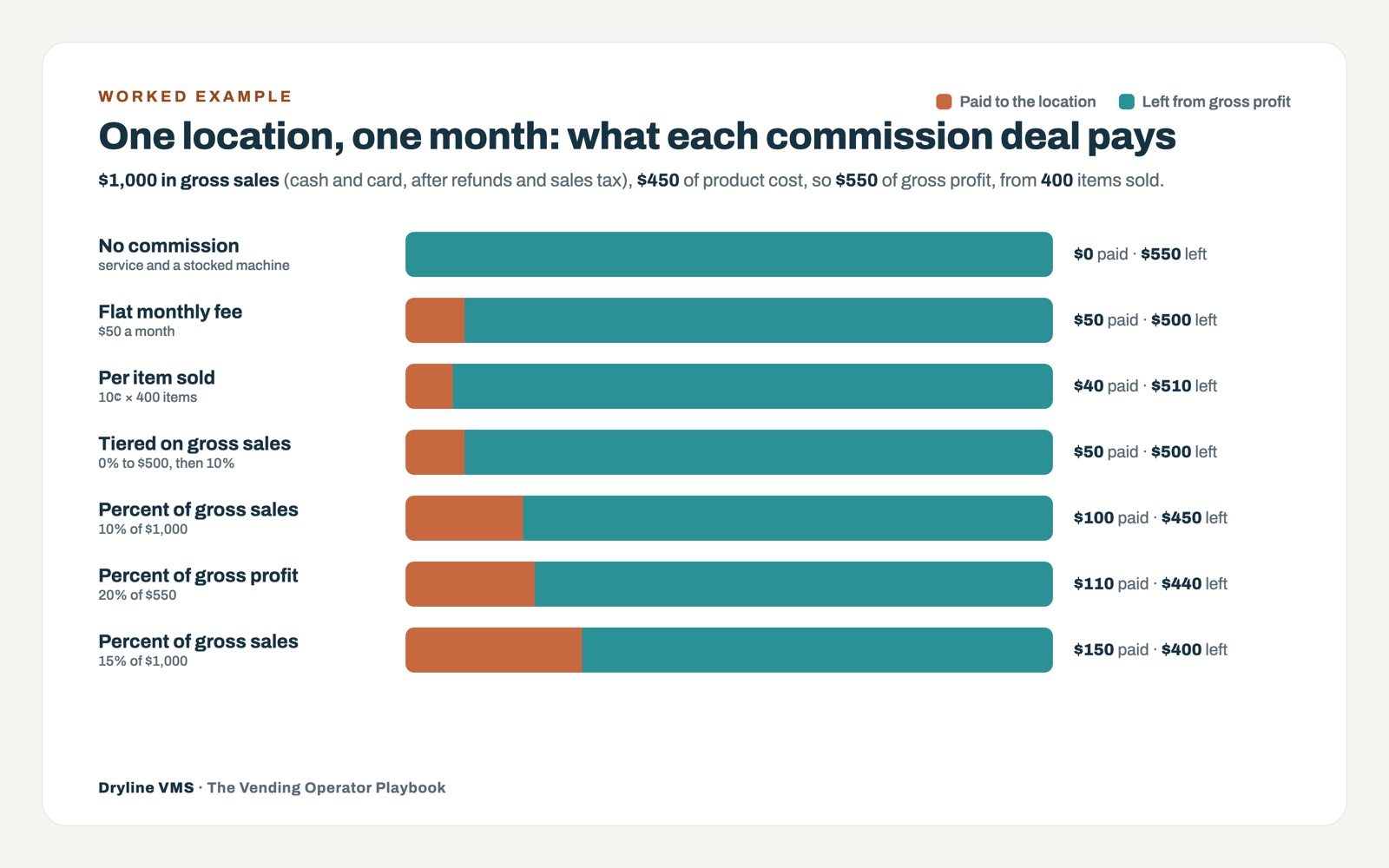
One location with $1,000 in gross sales and $450 of product cost: what each deal pays the location, and what is left of the $550 gross profit.
Three rules protect your margin. Calculate commission on gross sales, meaning all sales minus refunds and minus sales tax, because the tax belongs to the state. Start with no commission or a flat fee until a site proves itself, then share the upside with a tier. And before you agree to any rate, add up product cost, commission, card fees, fuel and the machine payment, because they all come out of the same dollar.
In Dryline VMS: location commissions take one rule per location (a percent of sales, a percent of profit, a fixed monthly amount or an amount per item), work out what each location is owed for any period on cash and card sales after refunds and sales tax, and produce a statement for each location that you mark as paid.
More in Vending location agreements and commissions.
What should you stock in a vending machine?
Start with products people already know, then let each location’s sales decide the rest. Snacks, candy and sweet baked goods still make up more than a third of vending and smart cooler sales, and jerky and protein bars lead the healthier picks (Automatic Merchandiser).
- Office: chips, candy, granola and protein bars, nuts, sparkling water and diet soda.
- Factory or warehouse: hearty snacks and larger sizes, pastries, jerky, energy drinks, cold water and sports drinks.
- Gym: water, sports drinks, protein bars and shakes.
- Apartment or hotel: late-night snacks, cold drinks and single-serve essentials.
- School: snacks sold to students during the school day must meet the USDA Smart Snacks standards, including no more than 200 calories and 200 mg of sodium per snack (7 CFR 210.11).
Healthier choices are worth a few coils everywhere: 65% of operators say clients ask for healthier product mixes (NAMA). Federal buildings follow guidelines that set standards for at least 75% of packaged snacks (HHS and GSA), and once you run 20 or more machines, the FDA requires calorie information for what you sell (FDA).
Fill each coil to its par level, the number you fill it to on every visit, rather than to the brim. A coil that holds 12 of a slow seller might have a par of 6, so your cash is not tied up in stock that ages in the machine. Give best sellers a second coil, keep one or two coils for testing new items, put fresh product behind older product, and write down what you throw away. Empty coils are common and costly. In an audit of 250 vending machines, 62% had at least one sold-out selection (Vending Times), and a study of 54 machines found that stock-outs cut profit 8% to 12% more than a simple estimate predicts, because a sold-out coil hides the demand for it (National Bureau of Economic Research).
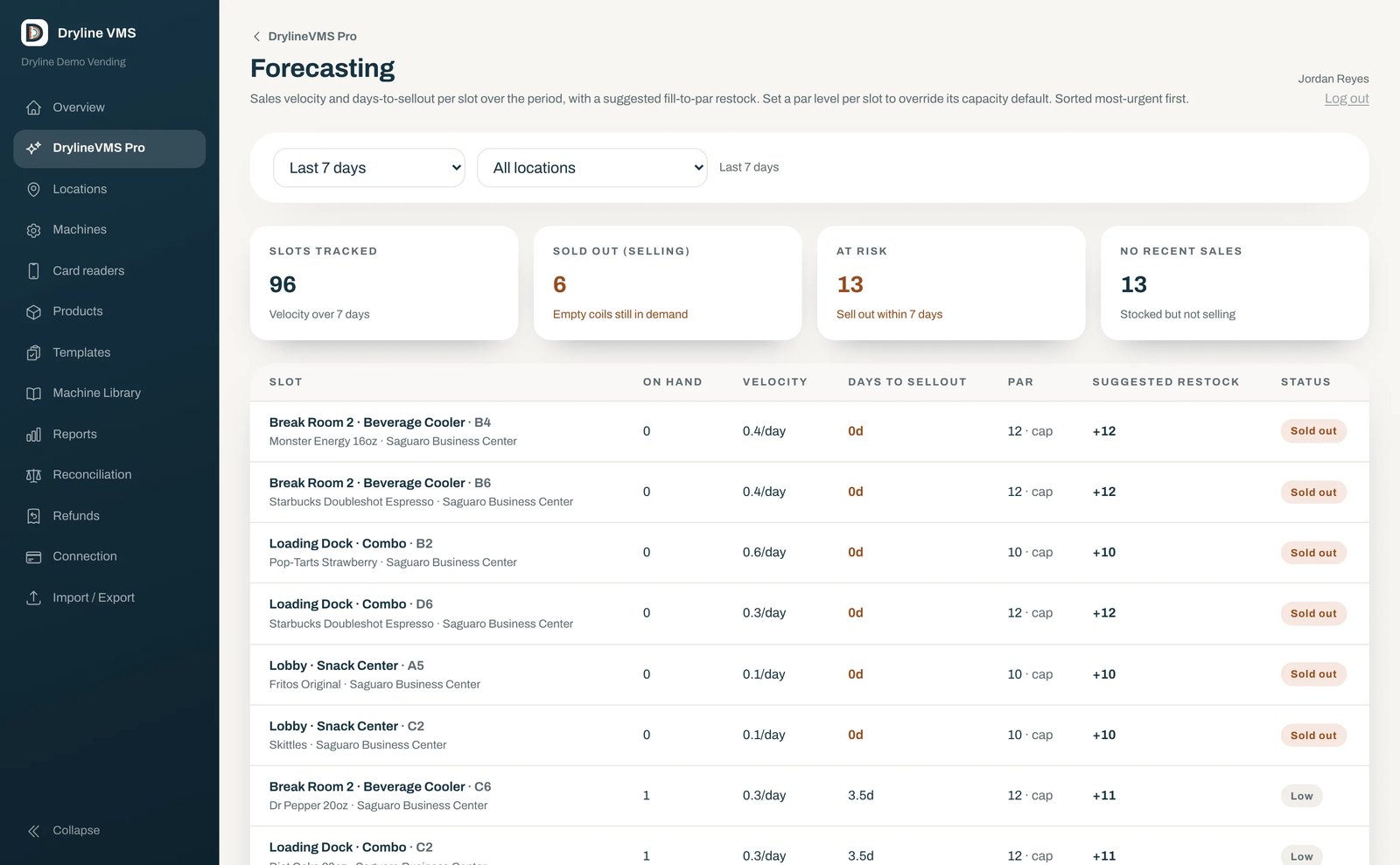
Forecasting in DrylineVMS Pro: how fast each selection sells, the days it has left and a suggested restock, with sold-out selections first.
In Dryline VMS: a pick list shows what to pull for each machine, coil by coil. Each restock can carry a best-by date, a daily email lists low and empty selections, and on DrylineVMS Pro forecasting suggests a fill to par for every selection.
More in Vending machine stocking strategies for beginners.
How should you lay out a vending machine?
A planogram is the map of one machine: which product goes in each coil (the metal spiral that holds a row of one product and turns to drop it), at what price, and how full to fill it. The person restocking works from it, so the machine is filled the same way every time.
- Put what you most want to sell at eye level. The CDC’s vending guidance places healthier items at or just below eye level, rows A to C in a snack machine, to sell more of them (CDC). In a university trial, healthier items grouped in eye-level rows with new labels rose to 21.3% of sales, against 1.3% in other machines (Nutrients, 2020).
- Two coils for the top sellers, side by side, so they sell out less often.
- Group by category, so someone looking for chips finds every chip in one place.
- Fit the product to the coil. A product that sits too loose or too tight jams.
- Keep a test slot and a request slot on every machine.
Every four weeks, rank each coil by units sold, swap out the slowest few, promote a test item that sold and try the next one.
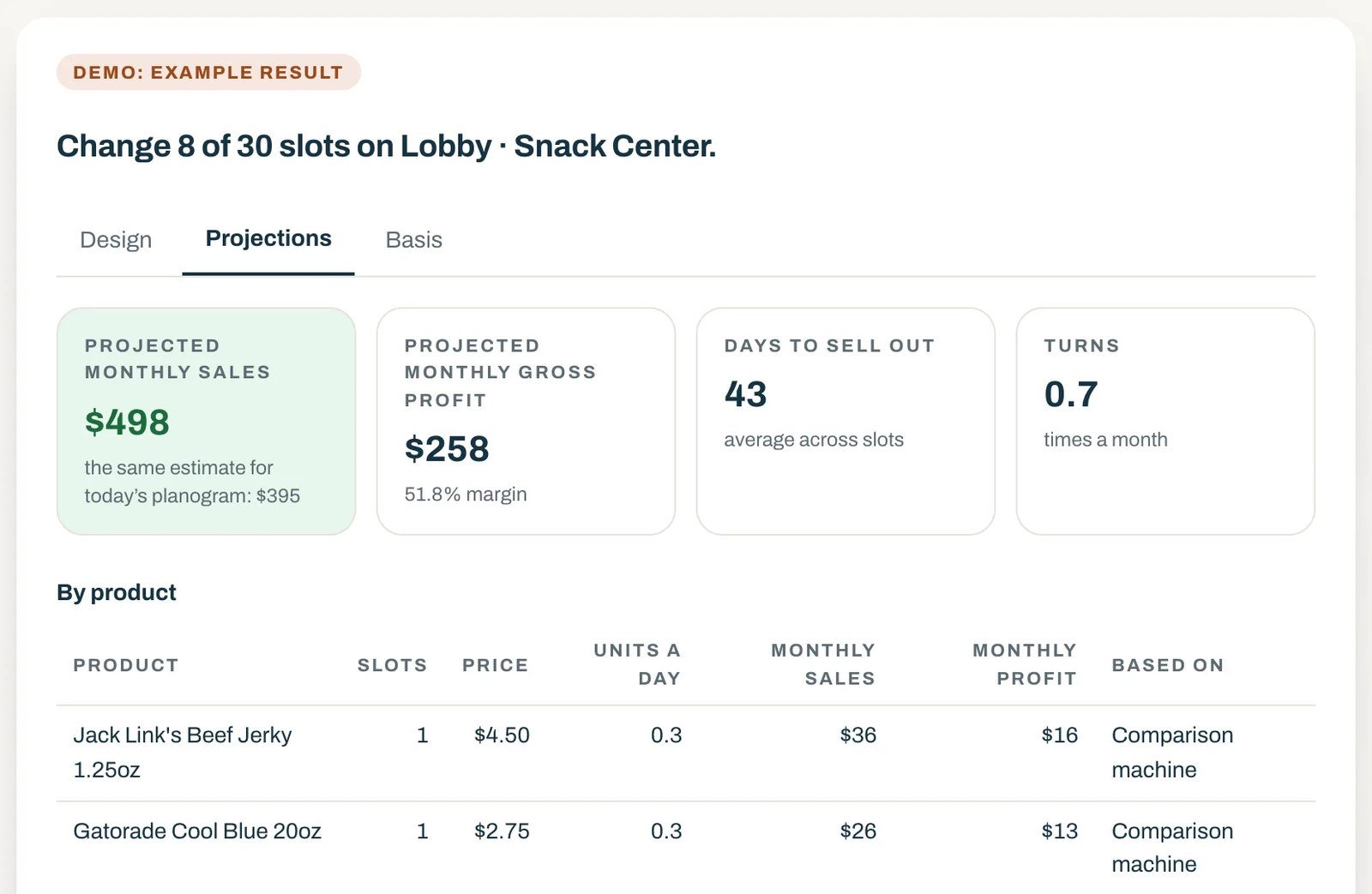
AI Planogram Assist projects a new plan’s monthly sales and gross profit from the machine’s own sales, beside the same figures for today’s planogram.
In Dryline VMS: scan a barcode to put a product in a coil, save a layout as a template, and review every change in plain English with a way to roll it back. On DrylineVMS Pro, AI Planogram Assist asks five short questions, then drafts a plan for the machine from your own products and sales, with the reason for every pick. Nothing reaches a machine until you publish it.
More in What a vending planogram is and how to build one.
Where do vending operators buy products?
Where you buy changes as you grow.
- Warehouse clubs suit your first machines: small quantities, with a paid membership (Sam’s Club starts at $60 a year, samsclub.com).
- Cash-and-carry wholesalers suit a growing route, with a business account and your resale certificate.
- Vending distributors suit a full route. Vistar, for example, runs 24 distribution centers for candy, snacks and drinks (Vistar). Ask each one about minimum orders and delivery days.
- Manufacturers, brokers and bottlers suit drinks and high-volume items. Ask your local bottler about its programs for operators.
- Online business buying suits specialty and healthier items. Check shipping time, case sizes and dates.
Products you buy to resell can be bought without sales tax when you give the seller a resale certificate. Texas, for example, exempts a taxable item bought for resale when the seller accepts a completed certificate, and a sales tax permit number alone is not a substitute (Texas Comptroller). States tax vending sales their own way, too: California taxes 33% of gross receipts from cold food sold in vending machines, and carbonated drinks in full (California CDTFA).
Work out the cost per unit on every purchase (the case price divided by the units in the case), order from your sales by product rather than from what is on promotion, check the dates before you buy, and keep backstock, the product you store between visits, to what your next few visits need.
In Dryline VMS: every product carries its unit cost beside its price. On DrylineVMS Pro, the central warehouse tracks the stock you hold and builds each route’s load in one step, listing any shortage before you leave.
How should you price vending products?
Customers pay for the convenience of a machine that is right there. The government’s price index for food from vending machines and mobile vendors rose about 50% from December 2019 to September 2026, and 2.0% in the most recent year (BLS), so check your prices against your costs at least once a year.
- Know the unit cost of every product.
- Set a target margin. Margin is the share of the price you keep after the product’s cost: (price minus unit cost) divided by price. A bag of chips that costs $0.95 and sells for $2.00 has a 52.5% margin. Vending prices include sales tax (Vending Market Watch), so take the tax out first.
- Check the nearest convenience store, not the grocery store.
- Use a simple price ladder by category, so similar items share a price.
- Change one price at a time when costs rise, and watch units sold for a few weeks.
A card pays the exact price, so a price no longer has to suit the coins in a pocket. If you are thinking about a card surcharge, Visa allows one only on credit cards, capped at 3% or your processing cost, and several states ban surcharges (Visa). One price for every customer is simpler.
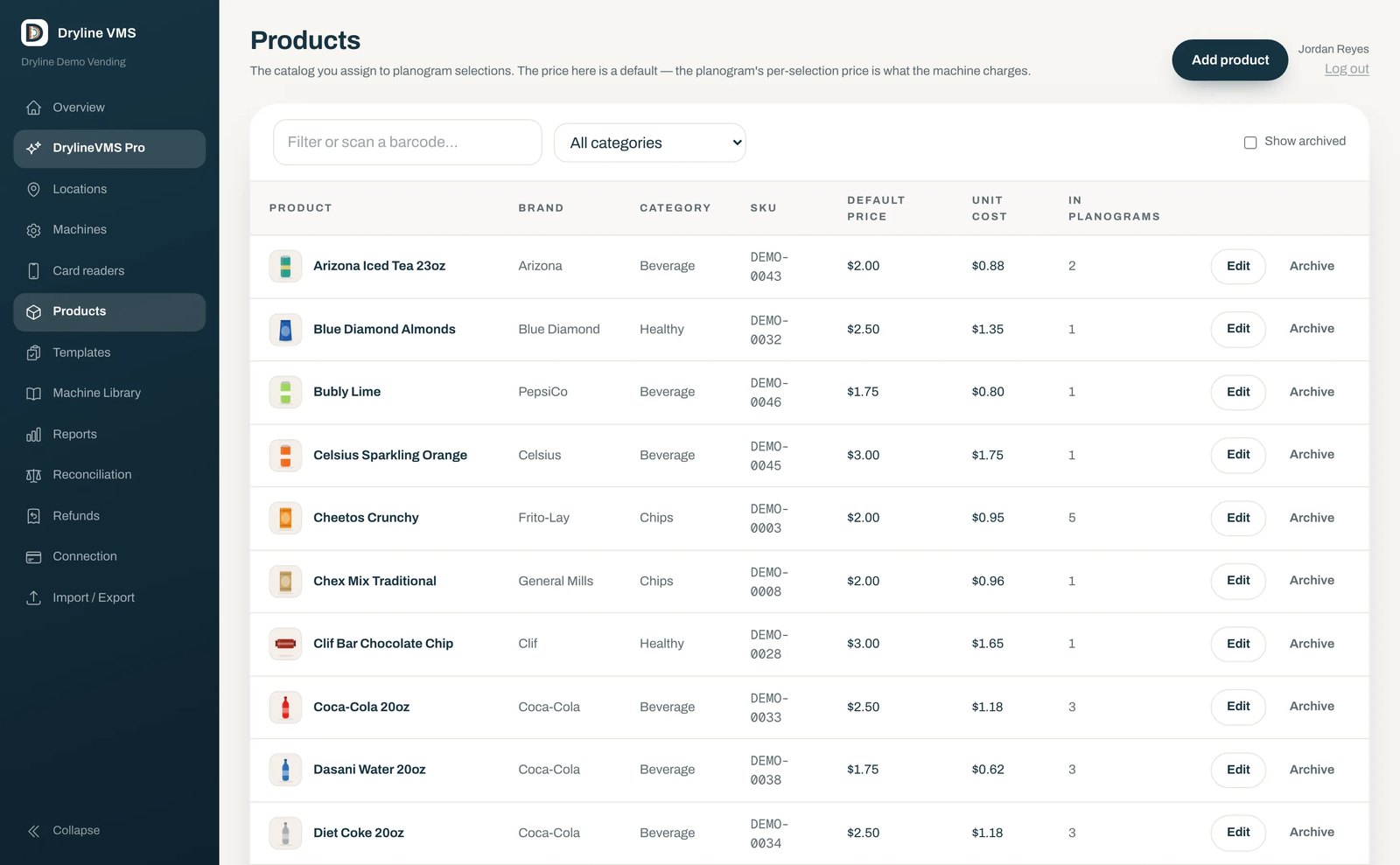
The product catalog in Dryline VMS keeps each product’s default price beside its unit cost.
In Dryline VMS: each selection’s price lives in the planogram, and on a card sale the Rain Pay reader asks for exactly that amount. Reports show sales and margin by machine and product, and the Tax Center works out the sales tax in each sale at the machine’s address.
More in Where to buy vending products and how to price them.
What should your first 90 days look like?
- Days 1 to 30: form the business, get your permits and insurance, build a lead list, score each site and sign your first locations.
- Days 31 to 60: install, stock to par, put your number on every machine, service on a schedule and track sales by product.
- Days 61 to 90: run your first planogram review, compare locations, fix or replace the weakest, and add machines only where a site has proved itself.
Each week, watch sales per machine, margin by product, coils that were empty when you arrived, stock thrown away, the share of sales paid by card, commission as a share of each location’s sales, and failed vends, the sales where nothing dropped.
Frequently asked questions
How much does a vending machine make?
The NAMA Foundation’s industry census estimated average revenue of $6,284 per vending machine in 2023, up from $4,032 in 2020 (NAMA Foundation and Technomic). That is sales, before product cost, commission and other expenses.
How do I know if a spot gets enough traffic?
Count it. Operators interviewed by Vending Times spend five or six hours counting the people who pass a location, because moving a machine 10 to 15 feet can change the count from 200 people to 10 (Vending Times, May 2023).
How long should I give a new location?
One operator writing in Vending Times advises three to four months of good-faith effort before judging a new location (Vending Times, April 2026). Use that time to adjust the product mix, the planogram and prices.
About Dryline VMS
Dryline VMS is AI-native vending management software that works as one system with the Rain Pay reader. It shows every machine as its real front, ties every card sale to the product that dropped, and reconciles each machine’s DEX count, the vends Dryline recorded and the card payments that settled. DrylineVMS Core comes with every reader, and DrylineVMS Pro adds the AI tools, forecasting, benchmarking and the route planner. There is no contract or activation fee, and support is US-based: Dryline VMS is based in Arizona, and you reach the team that builds it at 844-723-9732 or support@drylinevms.com.
Download The Vending Operator Playbook. The site scorecard, the location agreement checklist, commission math and a pricing worksheet in one printable workbook: get the PDF. Or book a 20-minute demo and set up your first machine with us.
Included In This Story

DrylineVMS
Run Unattended. Stay in Control.
Dryline VMS is vending management software for unattended retail operators. It shows each machine as its real front with product, price, and fill level per slot; builds planograms by scanning barcodes; reconciles DEX and settlement; and reports sales tied to the actual product sold. It imports and exports NAMA VDI 2.0.
Related Media
Subscribe
Get the latest news and resources from Vending Times.
Recent Posts