Vending
TendedBar, WeVend partner to expand automated beverage service beyond stadiums
Automated beverage technology company TendedBar is taking a step beyond its roots in stadiums and arenas through a partnership with unattended payments provider WeVend.
June 5, 2026 by Richard Slawsky — Editor, Connect Media
 ChatGPT
 Grok
Grok Perplexity
 Claude
Automated beverage technology company TendedBar is taking a step beyond its roots in stadiums and arenas through a new partnership with unattended payments provider WeVend. The agreement combines TendedBar's automated beverage dispensing platform with WeVend's payment infrastructure, creating a turnkey solution for operators in hospitality, transportation, foodservice and entertainment venues.
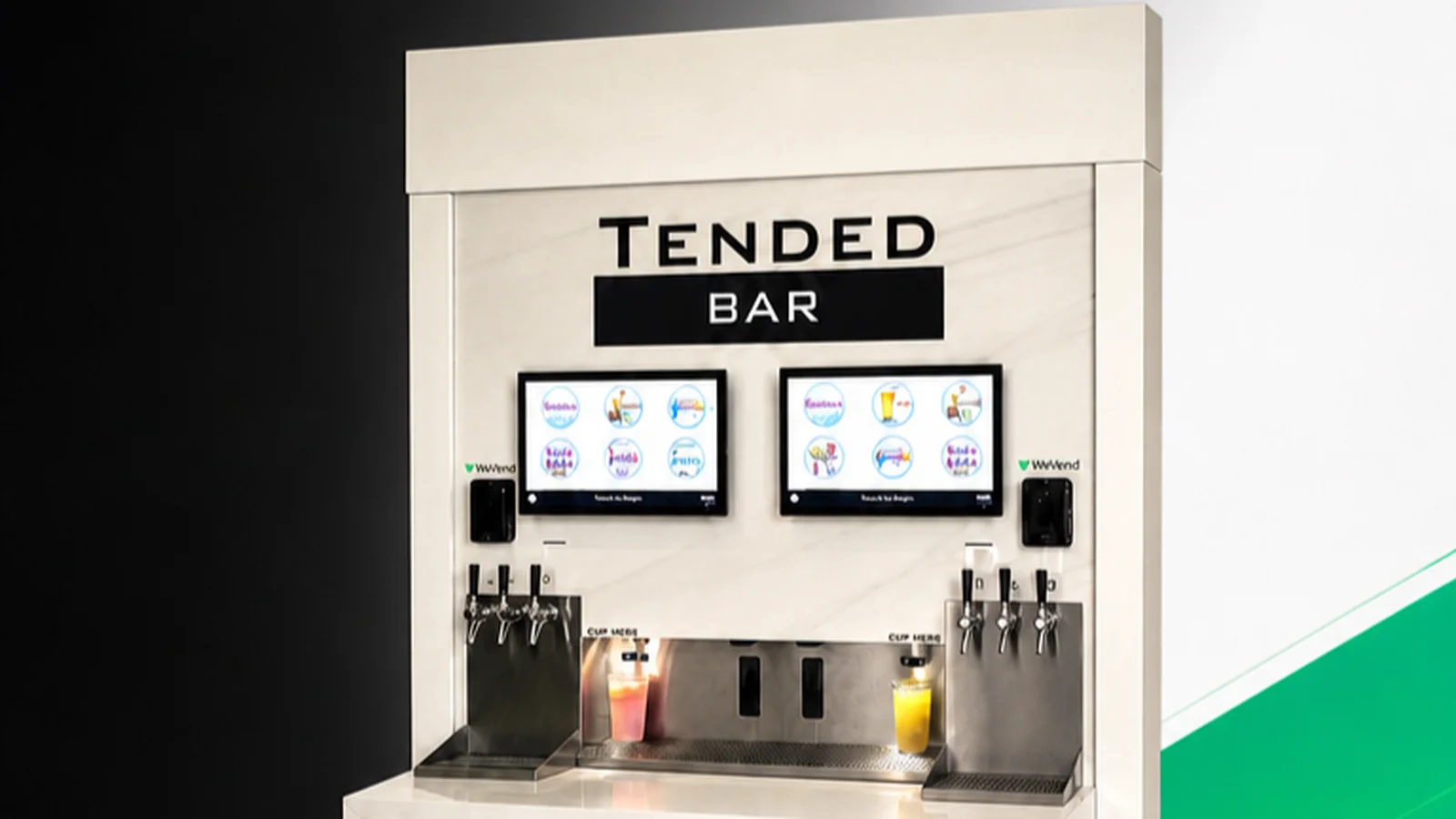
The partnership centers on TendedBar's new countertop beverage unit. While the company built its reputation serving cocktails in high-volume sports and entertainment venues, the smaller-format system is designed for hotels, quick-service restaurants, transportation hubs, micro markets and other locations where space and staffing are limited.
A larger dual-station vending unit, slated to launch in late summer 2026, is aimed at unattended and semi-attended deployments. The unit incorporates integrated ice dispensing and self-service functionality.
WeVend's payment technology adds support for tap, chip, swipe, QR code and mobile wallet transactions, giving operators a single platform for both beverage automation and payment processing.
"TendedBar has built technology that, until now, has been mostly seen by people in stadium seats," said WeVend president Peter Zoumboulakis in a press release.
"With our payment platform behind it, the same technology can move into a coffee bar in a hotel lobby, a beverage station inside a transportation hub, or a self-serve unit inside a quick-service venue," Peter Zoumboulakis said. "That is a meaningful expansion of where automated beverage service can go, and we are proud to be the partner enabling it."
"TendedBar has spent the past 10 years focusing on getting automated beverage service right in high-volume environments and is ready for the next step," said Justin Honeysuckle, co-founder and CEO of TendedBar, in an email interview.
"The technology works. The pour quality is consistent. The throughput is real," Honeysuckle said. "What this partnership does is take that proven platform and make it available everywhere a guest is thirsty, not just in venues that can support a four-screen front-of-house deployment."
Setting the stage for growth
Founded in 2014, TendedBar has evolved from an automated cocktail concept into a broader beverage automation platform.
Today, TendedBar has approximately 35,000 registered users and has deployed systems at venues including Allegiant Stadium in Las Vegas, Mercedes-Benz Stadium in Atlanta, Empower Field at Mile High in Denver, EverBank Stadium and Daily's Place in Jacksonville and Bank of Montreal Stadium in Los Angeles.
The company says it has launched systems at 19 venues over an 18-month period while refining its technology in some of the highest-volume beverage environments in the country.
TendedBar's flagship four-station units can pour drinks in as little as six to nine seconds, a capability developed specifically for venues where long concession lines can impact customer satisfaction and revenue. According to company data, a four-screen unit can produce up to 35 drinks in five minutes, and real-world testing has shown the platform serving customers at more than twice the rate of a traditional bar operation.
A critical component of the concept is age verification. The company learned early on that there is no one-size-fits-all answer because requirements can vary by state, venue type, service model and local regulations.
"TendedBar is designed to work with different levels of verification depending on the use case," Honeysuckle said.
"For the most autonomous alcohol deployments, we can combine ID scanning, mobile wallet registration and facial recognition to help verify the customer and connect that verification to the transaction," he said. "In other environments, the system may be operated by staff, placed behind the counter, or used in a more controlled service model depending on what the venue and local regulations require."
TendedBar's experience in stadium environments also generated insights into customer behavior. Case studies show repeat users spend significantly more than first-time users, while streamlined ordering options account for a large share of transactions. In one comparison at a major awards show, TendedBar served nearly three times as many customers as a traditional bar setup during the same period.
Beyond the bar
While alcohol service remains an important part of the business, Honeysuckle said demand is increasingly being driven by nonalcoholic beverages. Categories such as dirty sodas, refreshers, iced coffee, flavored energy drinks and specialty teas are creating new opportunities for operators seeking premium beverage programs without the complexity of a full bar.
Hospitality operators also continue to face labor shortages and rising wage costs, increasing interest in self-service technologies that can expand beverage offerings, improve service speed and reduce staffing requirements.
"Operators are not only asking, 'How do I serve cocktails faster?'" Honeysuckle said. "They are also asking, 'How do I offer more beverage variety without slowing down service or increasing labor?'"
That trend is reflected in the company's newest platforms. TendedBar's countertop system is designed for crew-served environments such as concession stands, airports, theme parks and entertainment venues. The unit supports beverages ranging from refreshers and boba drinks to iced coffee, cocktails and wine, while allowing operators to use their preferred syrups and ingredients without proprietary supply contracts.
Flexibility has become a key part of the company's strategy. TendedBar can operate in attended, semi-attended or unattended environments and supports a range of payment and identity-verification options depending on local regulations and venue requirements. For alcohol sales, the platform can incorporate ID scanning, mobile registration and facial-recognition tools, while nonalcoholic deployments may require little more than payment processing and recipe management.
Opening new unattended retail channels
The WeVend partnership could help accelerate adoption by bringing TendedBar into channels where unattended retail and self-service technology are already established. WeVend serves operators in vending, parking, car wash, laundry and smart retail, providing a distribution network that extends well beyond sports venues.
For TendedBar, that creates opportunities to deploy its technology in locations that previously may not have had the scale or infrastructure to justify automated beverage service.
"The WeVend partnership is important because it helps bring TendedBar into environments where automated retail, unattended payments and compact beverage solutions already make sense," Honeysuckle said. "It expands the opportunity beyond traditional bars and stadiums into hotels, transportation hubs, micro markets, QSRs, offices and hospitality spaces where operators need more beverage variety without adding labor complexity."
The partnership comes as demand for automated beverage service continues to expand. Industry analysts project annual growth rates for automated beverage service ranging from the mid-single digits for commercial beverage dispensers to more than 10% for beverage dispensing automation systems, reflecting increasing adoption across hospitality, transportation, entertainment and unattended retail environments.
As consumer demand continues shifting toward customized beverages, functional drinks and frictionless service, the partnership positions both companies to capitalize on a market increasingly looking beyond traditional concession stands and bar counters. If stadium deployments proved automated beverage service could handle high-volume crowds, the WeVend partnership may determine whether the model can scale across the broader unattended retail market.
About Richard Slawsky
In addition to writing, Slawsky serves as an adjunct professor of Communication at the University of Louisville and other local colleges. He holds both a Bachelor’s and a Master’s degree in Communication from the University of Louisville and is a member of Mensa and the National Communication Association.
Related Media
Subscribe
Get the latest news and resources from Vending Times.
Recent Posts