Vending
The true cost of vending: Why zero cost Is not too good to be true
Modern vending should not be something a client has to nurse along. It should be a managed service that quietly does its job: stocked, monitored, maintained and ready when people need it.
June 25, 2026 by Dave Berman — Co-Founder & Director, VendEase
 ChatGPT
 Grok
Grok Perplexity
 Claude
Whenever I speak to facilities, procurement or estates teams about zero-cost vending, I can usually see the same thought forming behind the polite smile.
There must be a catch.
I do not blame them. In most areas of business, "zero cost" is either a teaser, a subsidy, or small print waiting to happen. Procurement people are paid to be skeptical, and rightly so.
But in managed vending, the zero-cost model is not a trick. It is a different commercial structure.
The client provides the space and access. The vending operator provides the machine, installation, stock, servicing, maintenance, repairs and technology. The service is funded through product sales. The customer pays for what they buy. The client organization does not pay for the vending service.
The more interesting question is why so many organizations still carry responsibilities they no longer need.
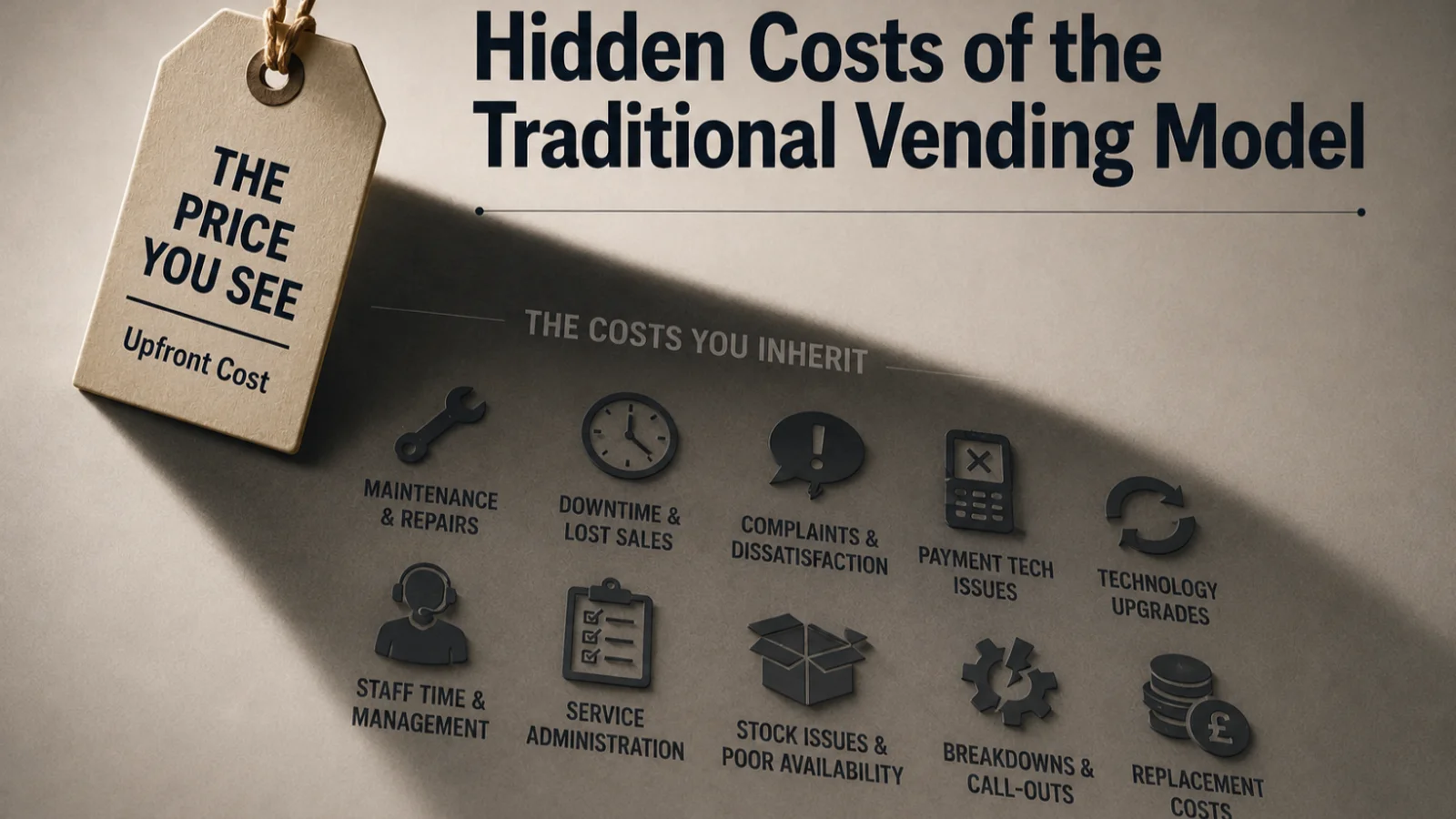
The old model had more cost than people realized
The traditional approach to vending often made the client responsible for far more than they expected.
A machine might be bought outright or leased. Maintenance might sit under a separate arrangement. Call-outs might create additional charges. Someone internally had to deal with complaints, chase the provider, monitor performance and decide whether the machine was worth keeping. If the machine became outdated, the client had to think about replacement. If contactless standards moved on, there was another upgrade conversation.
None of this always appeared neatly on one invoice marked "vending cost". That is part of the problem.
The real cost was spread across capital expenditure, maintenance, management time, downtime, staff frustration, user complaints and poor service visibility. It was easy to miss because it was fragmented.
In my time at VendEase, I have seen organizations assume vending was costing them very little, when in reality it was absorbing time, attention, and goodwill. That is a cost too, even if it does not sit neatly in the finance system.
Why managed vending changes the calculation
A fully managed vending model turns the responsibility around.
The operator owns the machine, maintains it, stocks it, monitors it and replaces it when required. The client is not trying to become a vending expert on top of everything else they already do. They are simply making a useful service available to the people in their building, hotel, campus, site or facility.
That shift matters because vending only works when it is reliable. A machine that is empty, broken or full of products nobody wants is not an amenity. It is an irritation with a plug socket.
Under a proper managed model, the operator has every incentive to keep the machine working. If the machine is not stocked, it does not sell. If it does not sell, the operator does not earn. The commercial incentive is aligned with the service outcome.
That is why "zero cost" should not be confused with "low value". The model works because value is created through usage, not through charging the host site.
Risk belongs with the operator
One of the most underappreciated benefits of managed vending is risk transfer.
Machines age. Payment technology changes. Product expectations shift. Energy standards evolve. Parts fail. Screens, card readers and refrigeration units all have lifecycles. Under an ownership or lease model, those issues can eventually become the client's problem.
Under a fully managed model, they are the operator's problem.
That is where they belong. A vending operator should understand the equipment, the service requirements, the product mix, the telemetry, the maintenance pattern and the replacement cycle. A facilities or estates team should not have to spend time deciding whether a machine motor is nearing the end of its useful life. They have rather more important things to be getting on with.
This is where my own background probably colors the way I see it. Before VendEase, I spent time in the Royal Marines, where there was a simple principle: responsibilities had to be clear. If something mattered, somebody owned it. Ambiguity was not a strategy.
The same applies here. If vending is going to be part of the service environment, responsibility for making it work should sit with the people best equipped to manage it.
Total cost is not just price
When organizations review vending, the conversation too often starts and ends with price. What does the machine cost? What is the lease? What are the maintenance terms?
Those are fair questions, but they are not the whole calculation.
A proper total cost view should include capital cost, maintenance exposure, management overhead, downtime, user dissatisfaction, technology obsolescence and the practical risk of poor service. It should also ask what value is being created for the people using the machine.
In a workplace, reliable vending supports staff convenience. In a hotel, it reduces late-night pressure on reception. In a university, it helps students access food, drink and essentials outside normal catering hours. On a construction site, it contributes to welfare provision. In healthcare, it supports staff, patients and visitors when catering outlets are closed.
Those benefits are not abstract. They are small daily moments where the environment either works for people or lets them down.
The right question to ask
I understand why "zero cost" invites scrutiny. It should. Any serious provider should be able to explain how the model works, what is included, what is not, how machines are monitored, how faults are handled and how product ranges are managed.
But once those questions are answered, the conversation should move on.
The better question is not, "What is the catch?"
The better question is, "Why would we take on cost, risk and management burden when we do not have to?"
Modern vending should not be something a client has to nurse along. It should be a managed service that quietly does its job: stocked, monitored, maintained and ready when people need it.
That is the real value of the zero-cost model. Not that it sounds attractive in a proposal, but that it removes unnecessary friction from the client and puts responsibility where it belongs.
And, in my experience, the best services tend to have that quality. They do not make life more complicated. They make it easier.
About Dave Berman
Dave Berman is the Co-Founder of VendEase, a leading UK-based automated retail operator revolutionising the sector alongside his business partner, Jonny Holmes. From their London headquarters, the duo has established VendEase as a top-tier partner, renowned for tech-led programmes and a 'fully managed' model. Today, the business boasts high profile clients and partners, including Premier Inn, University of Greenwich, and Mars, Inc., delivering bespoke solutions that place VendEase at the very forefront of modern British vending.
Related Media
Subscribe
Get the latest news and resources from Vending Times.
Recent Posts