Foodservice
Hot meals are back in the [vending] box
Hot food vending is no longer a novelty. It is a response to real market pressures and a sign that, once again, vending is pushing beyond its historical boundaries
February 20, 2026 by Richard Slawsky
 ChatGPT
 Grok
Grok Perplexity
 Claude
For decades, vending machines were defined by cold sandwiches, shelf-stable snacks and microwavable popcorn or bean burritos. Hot food vending, while occasionally attempted, was often viewed as too complex, too risky or too costly.
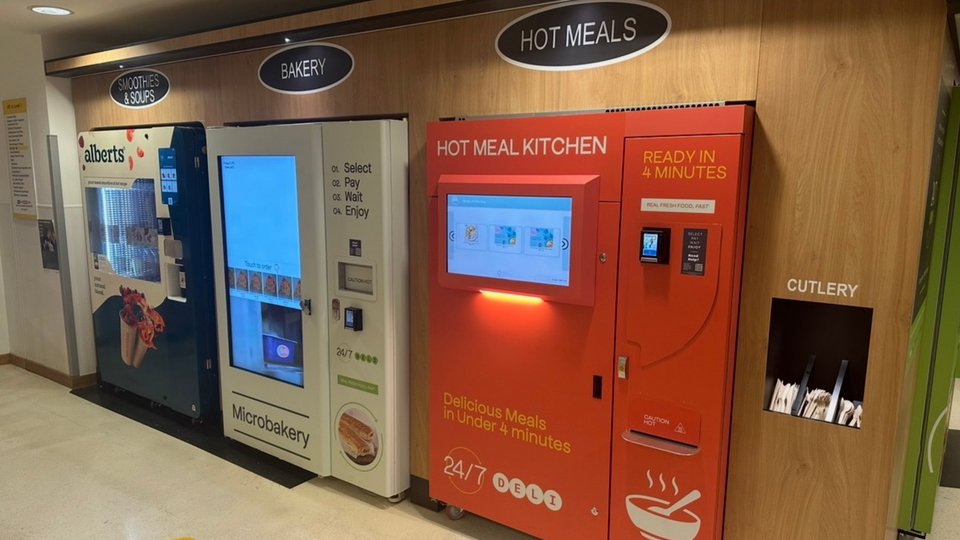
Today, that perception is changing. Across venues such as hospitals, factories and college campuses, a new generation of hot-food vending machines is reshaping automated retail.
The resurgence isn't likely to be a passing fad, either. Instead, it reflects deeper shifts in labor economics, food technology and consumer behavior that are converging to make freshly prepared, on-demand meals viable in unattended formats.
Recent estimates predict the hot food vending machine industry in the U.S. and Canada will top $9.6 billion by 2036, a 6.6% compound annual growth rate from $5.5 billion in 2026.
Technology that finally caught up
One of the most significant drivers behind the growing popularity of hot food vending is a change in consumer expectations.
Today's customer is accustomed to freshly prepared food delivered quickly, whether through quick-service restaurants, delivery apps or convenience retail. Dining on a cold wrap or reheated burrito no longer aligns with how people think about meals, especially when they are paying restaurant prices.
"We are seeing the current growth in hot food vending being driven not by novelty or convenience but by the elevated foods the latest technology can deliver," Benoit Herve, founder and CEO of Sunnyvale, Calif.-based LBX Food Robotics, said in an email interview. "Today's consumers expect healthy options, a changing menu with lots of variety, and most importantly, true restaurant quality, whether it is a pastry, gourmet breakfast sandwich or crispy-crust pizza."
LBX Food Robotics operates around 200 Bake Xpress robotic hot food vending kiosks, mainly in the U.S.
Hot food vending addresses the desire for a better food experience. Machines capable of baking, steaming or rapidly heating food on demand promise something closer to a made-to-order experience, without the staffing overhead of a traditional kitchen.
"Key enablers include precise temperature-controlled refrigeration and high-speed integrated heating such as microwaves, convection air fryers or infrared for uniform cooking in minutes, along with IoT for real-time inventory, remote monitoring and predictive maintenance," Walter Gill, a 40-plus year veteran of the U.K. vending industry, said in an email interview.
Gill and co-Founder Bert Wallace were former U.K. partners for 365 Retail Markets and introduced the first smart fridge there in 2017. They deployed hot food pods in two U.K. hospitals in 2023 and have since secured investment to develop their own custom kiosks.
"These have overcome earlier challenges around food safety, consistency, and preparation time," Gill said. "Machines now reliably heat complex items like pasta, pizza or burritos from chilled or frozen state in under three to five minutes."
By many indications, there's an eager market for hot food vending. About 4% of all U.S. workers work the night shift, for example, equating to about 6.4 million workers. Factory workers, hospital staff and package handlers are just a few of those punching in as the clock strikes midnight.
And while those facilities may have staffed foodservice operations during the day, it's often not cost-effective to keep those services running around the clock. For those on the midnight shift, that left them with the option of a wrapped-up ham sandwich, a bag of chips or maybe a candy bar to carry them until dawn. Due to time constraints or liability concerns, many of those workers are discouraged or even forbidden from traveling off-site to get a hot meal.
Others might be enduring a late-night layover at an airport after most dining venues have closed. Maybe they've stopped at a hotel off the interstate, and no nearby food options are open. Or maybe they're living in a college dorm and on a limited budget.
Scenarios like these, along with persistent labor shortages in food service pushing facilities toward automation, a post-pandemic emphasis on contactless/touchless options, and the shift toward healthier, fresher prepared foods, are helping to drive the growth of hot food vending.
In many cases, hot-food vending does not directly compete with restaurants. Instead, it fills gaps such as late-night hours, off-peak demand or other underserved scenarios, where providing staff or guests with access to hot food can be a major satisfaction booster. This complementary role has made facility managers and owners more receptive, particularly as they seek additional amenities without increasing staffing complexity.
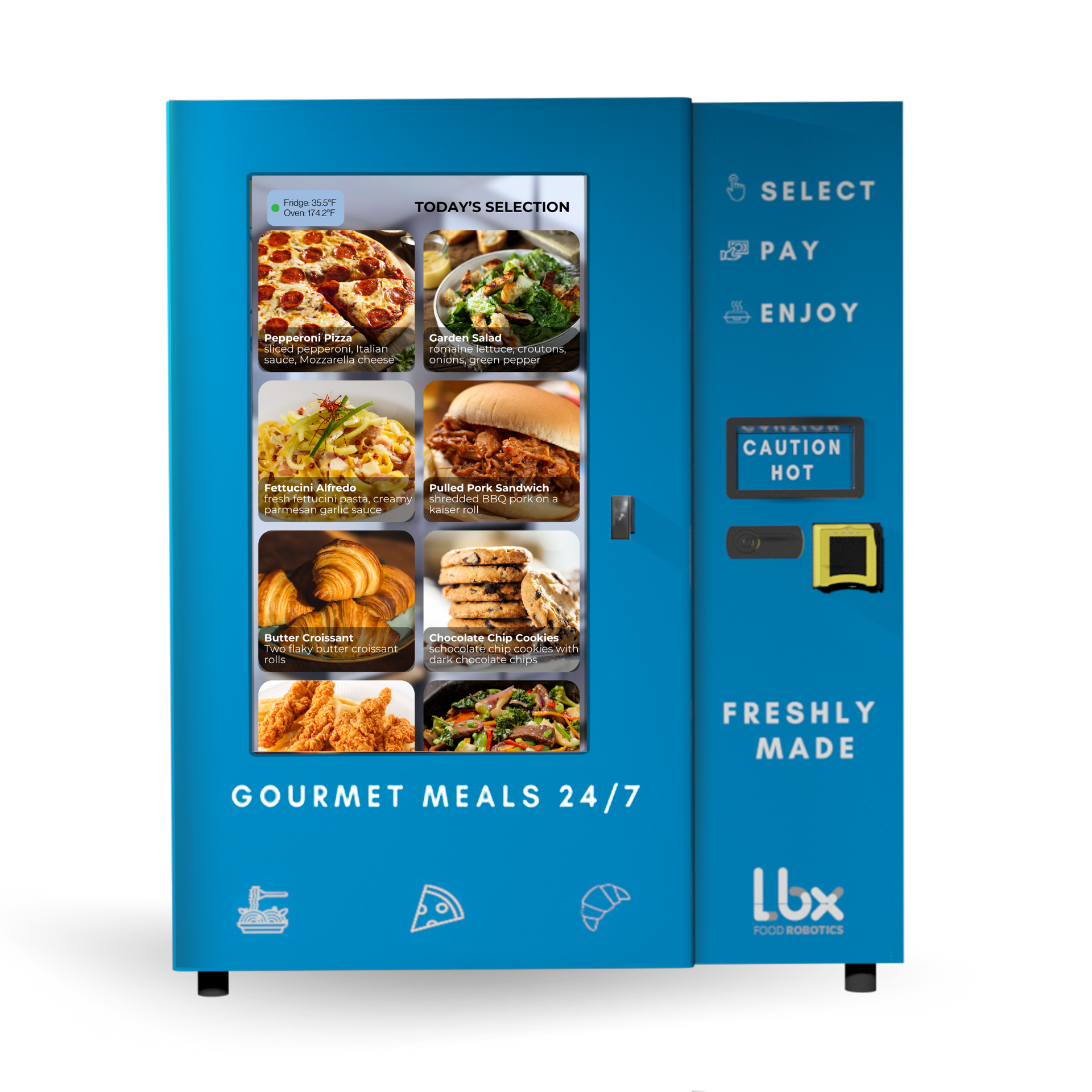
Photo: A Bake Xpress robotic hot food vending kiosk.
Technology beginning to catch up
Arguably, the first attempts at serving hot food via vending machines were the Automat restaurants that once operated in several cities around the world in the late 1800s and early 1900s. The food sat in a bank of cubbyholes behind small glass doors. The diner dropped in coins, turned a knob and the door popped open. Kitchen staff on the other side of the wall kept the cubbies stocked.
Sadly, the last Automat in New York closed in 1991, its popularity and convenience supplanted by fast-food restaurants.
Other attempts at hot food vending often failed because the technology wasn't ready. Cooking consistency, food safety, cleaning requirements and mechanical reliability posed significant challenges. Today's systems are significantly different.
Consider the many variations of pizza vending machines appearing in the marketplace. Toronto, Ontario-based PizzaForno, for example, has more than 70 operating locations, including more than 30 in the U.S.
In PizzaForno's model, as many as 70 pizzas are stored in a refrigerated compartment at about 37 °F. The pizzas arrive frozen and are thawed under controlled conditions once stocked. An inventory system tracks stock expiration dates so pizzas are sold within their allowable window, up to about 96 hours.
Users select their desired pizza on an interactive touchscreen and pay by credit/debit card or other electronic payment method. Pizza choices include Meat Lovers, Pepperoni, Cheese, Vegetarian, Barbecue, and even Breakfast Pizza as well as a rotating Pizza of the Month, with limited-time offerings such as Margherita, Kraft Mac and Cheese, Jalapeno and Hot Honey.
"From our machines on East Coast campuses, we've seen that 70% of pizza sales happen between 10 p.m. and 6 a.m.," Travis Musser, Master Licensee for PizzaForno Southern California and Washington State, said in a press release. "Having food available round the clock keeps students safer on campus — they don't have to leave at 2 a.m. just to grab something to eat."
On the UC Berkeley campus in California, a fried chicken vending machine recently began operating in the Martin Luther King Jr. Student Union. The machine, dubbed brd BOT, uses an internal deep fryer to cook portions of popcorn chicken to order.
"Brd BOT, at its core, is robot fried chicken," UC Berkeley alumnus Syed Saquib, the co-founder and CEO of brd BOT, told the Daily Californian. "Oftentimes you go get fried food, but it comes out as a soggy piece of s---. And that happens because it's been sitting under that heat lamp for 10, 15 minutes, so by the time you get it … it's just a mess."
And the Bake Xpress machines operated by LBX Food Robotics offer dishes such as gourmet sandwiches, artisan pizzas, pasta dishes and pastries. Bake Xpress uses a combination smart oven that merges convection, infrared and microwave heating to bake or heat foods on demand.
"Advanced heating and integrated intelligence deliver this high level of flexibility and quality, allowing operators to serve places and times that traditional food service simply can't reach, such as remote gates at an airport, campus locations when dining is closed or hospital waiting rooms overnight," said LBX Robotics' Herve.
Many hot food vending machines, including brd Bot's, rely on partially prepared or par-cooked items that are finished on demand. Sensors, timers and automated temperature controls help ensure consistent results, while enclosed cooking chambers reduce cross-contamination risks. Some machines track cooking cycles digitally, enabling operators to monitor performance remotely and receive alerts if temperatures drift outside acceptable ranges.
These improvements are helping to reduce both operational risk and consumer skepticism. When a customer sees fries, pizza, or noodles prepared in real time rather than reheated from a questionable source, the perceived value increases dramatically.
Food safety and trust remain central concerns
Despite technological progress, consumers are understandably cautious about unattended cooking systems.
Operators that succeed tend to emphasize transparency. Clear signage explaining how food is prepared, visible cooking processes and robust cleaning protocols all help build trust. Some machines incorporate viewing windows or real-time status displays to reassure customers that food is being prepared safely and freshly.
Behind the scenes, compliance with local health codes can vary significantly by jurisdiction, adding complexity for multi-market operators. Permitting, inspection, and labeling requirements often require close coordination with local authorities. While this slows rollout, it also raises the barrier to entry, preventing many from getting into the market but potentially benefiting operators willing to invest in compliance.
Hot food vending also marks a shift in pricing. While traditional vending has long been associated with low-cost items, hot food machines often command prices comparable to those of quick-service restaurants.
This pricing flexibility improves the unit economics for operators but raises the stakes. A poorly cooked meal or inconsistent experience can quickly sour customers, particularly when alternatives are nearby.
A category still taking shape
While interest is growing, hot food vending remains an emerging category rather than a mature one.
Questions around standardization, maintenance costs, menu flexibility and long-term reliability are still being answered. Operators are learning which foods travel best through automation, which locations deliver consistent demand, and how much education customers need before adoption becomes routine.
What is clear, however, is that hot food vending is no longer a novelty. It is a response to real market pressures and a sign that, once again, vending is pushing beyond its historical boundaries
About Richard Slawsky
In addition to writing, Slawsky serves as an adjunct professor of Communication at the University of Louisville and other local colleges. He holds both a Bachelor’s and a Master’s degree in Communication from the University of Louisville and is a member of Mensa and the National Communication Association.
Related Media
Subscribe
Get the latest news and resources from Vending Times.