Vending
“Better for You” options fueling new vending opportunities
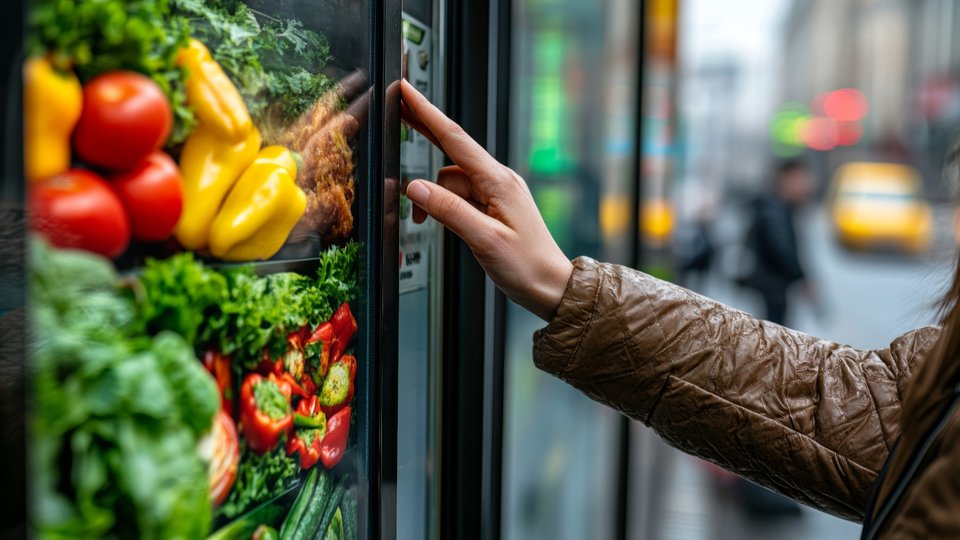
Vending machines are becoming a strong channel for delivering those “better for you” food options in corporate offices, healthcare facilities, schools and public venues.
December 18, 2025 by Richard Slawsky
 ChatGPT
 Grok
Grok Perplexity
 Claude
Long synonymous with soft drinks, candy bars and salty treats, snack vending machine operators are increasingly embracing healthier assortments as consumer expectations shift toward wellness as a companion to convenience.
The trend is helping shape purchasing behavior, equipment investments, and location requirements across the entire vending ecosystem.
One of the drivers of the vending machine market, according to a recent Grand View Research report, is the increasing availability of healthier and premium product options. The firm forecasts the sector will grow at a 3.2% compound annual rate over the next several years, topping $19.9 billion by 2033.
A Ken Research study echoes those findings, citing evolving consumer preferences for healthy and fresh food options.
Campbell's Food Service highlighted a more than 40% increase in the sales of healthy and plant-based items in vending and micro-markets in its 2022 State of the Vending & Micro Market Industry Report, a growth rate that far outpaced traditional snack categories. And vending machine manufacturer Wider Matrix listed a health and wellness focus as one of its top trends for 2025.
Defining healthy in vending terms
Of course, labeling a vending machine as selling "healthy" or "nutritious" products can be a regulatory minefield. The U.S. Food and Drug Administration has strict rules regarding such claims, and running afoul of those rules can trigger enforcement actions such as relabeling requirements or even lawsuits.
Although it's wise to seek legal advice before making any labeling claims, describing a product's specific attributes, such as "10 g of protein," "only 3 g added sugar," or "120 calories per serving" is likely a safer bet, as long as they are accurate. According to the FDA, these claims fall under the category of "nutrient-content claims," leaving it to the purchaser to make their own decision.
Items likely to attract the interest of health-conscious consumers include:
- Shelf-stable items such as granola bars, dried fruit, and trail mix.
- High-protein snacks.
- Plant-based, gluten-free, or low-sugar options.
- Specialty beverages including low-sugar hydration drinks and energy blends.
Additionally, the category is expanding beyond packaged snacks. The Hayward, Calif.-based FoodSpot, for example, has developed RFID-enabled "healthy food vending machines" that dispense fresh meals, salads, wraps, and other ready-to-eat foods in airports, campuses, hospitals, and other venues. Another example is the Chicago-based Farmer's Fridge, which operates fresh-food vending machines serving salads, bowls, and meal-type items in hospitals and airports.
Where healthy vending takes hold
Although nearly any location hosting a food vending machine is ripe for healthier product mixes, several categories are emerging as consistent winners.
Corporate offices, athletic facilities and similar venues where people gather and work are among the prime locations for successful healthy vending. Users of those venues often seek snacks that support energy, focus, and productivity.
"Locations found to have the most success include large work complexes, gyms, and in certain schools," said Shelley Balls, MDA, RDN, LDN, a registered dietitian and nutritionist for Jordan, Utah-based supplement provider Flawless Bloom, in an email interview. "The success of these healthy vending machines is largely driven by the modern desire to become healthy and stay healthy."
Hospitals and healthcare campuses can also be prime spots for healthy vending. With many employees in those locations often working through long shifts, access to nutritious items can influence both performance and alertness.
"In environments where I was training, some clinicians needed to have rapid access to nutrition that could keep them going throughout long cases," said Brian Clark, a certified registered nurse anesthetist and founder of Provo, Utah-based United Medical Education.
"I became familiar with the ways that vending choices affected clinician performance," Clark said in an email. "Our anesthesia teams were also monitoring fatigue-related errors, and administrators began to notice that staff members were choosing the type of snack that would provide them with a steady supply of energy as opposed to one that would cause a rapid increase in blood sugar levels."
In educational institutions, nutrition guidelines formulated by the Centers for Disease Control are encouraging institutions to adopt healthier options. Still, a 2023 study published in the Journal of Public Health Research points out that legacy equipment filled with high-sugar selections can create implementation challenges, although an earlier study published in the Journal of School Health found that in situations where healthier assortments are provided, students tend to choose those items without a reduction in overall vending usage.
The strongest argument for healthy vending
Of course, vending operators need to consider the bottom line when making changes to their offerings and anecdotal evidence appears to support such a move.
A blog post on the website of Boca Raton, Fla.-based DFY Vending claims that healthy vending machines outperform those offering traditional snacks by 57% in terms of profitability, especially in schools, gyms and corporate offices.
Although there are no academic studies proving a sales increase, several suggest that switching to healthier vending can maintain overall sales and increase customer satisfaction.
Still, operators still face challenges when it comes to stocking perishable items or those that need to be kept under refrigeration. Those machines will likely require daily restocking, leading to higher operating costs. IoT and RFID inventory tracking can help alleviate at least some of those costs.
Clearly, though, vending machines are becoming a strong channel for delivering those "better for you" food options in corporate offices, healthcare facilities, schools, and public venues. If current trends are any indication, healthy vending will continue to expand.
About Richard Slawsky
In addition to writing, Slawsky serves as an adjunct professor of Communication at the University of Louisville and other local colleges. He holds both a Bachelor’s and a Master’s degree in Communication from the University of Louisville and is a member of Mensa and the National Communication Association.
Related Media
Subscribe
Get the latest news and resources from Vending Times.