Vending
Prescription pickup lockers offer practical solutions
As pharmacies continue to grapple with staffing shortages, expanding clinical responsibilities, and rising customer expectations, prescription pickup lockers provide a practical solution.
December 5, 2025 | Richard Slawsky
Chances are we've all been there. We make a trip to the pharmacy to pick up a much-needed prescription only to find out the pharmacy counter is closed, or worse yet, on an hour-long lunch break. Or maybe we've waited patiently at the drive-up window while the person in line in front of us peppers the tech at the window with dozens of questions, ranging from what their insurance covers to what's on sale in the store this week.
Whatever the cause, the delays and wait times involved in picking up those prescriptions appear to have worsened in recent years. With that in mind, pharmacy pickup lockers are gaining traction as a way to combat wait times, smoothing out workflows on one side of the counter while enhancing the customer experience on the other.
It's not your imagination
Increased wait times at the pharmacy counter aren't just in the minds of pressed-for-time consumers. They're a reality.
Many pharmacies report being short-staffed in both pharmacists and pharmacy technicians. In a recent survey published in the American Journal of Health-System Pharmacy, more than 80% of pharmacy directors reported shortages of experienced pharmacy technicians, and about 60% reported shortages of clinical pharmacists/specialists.
At the same time, the duties of pharmacy staff have expanded to include tasks such as administering vaccines, giving COVID-19 tests, and advising customers on ways to monitor blood sugar or quit smoking.
Those factors, and others, are prompting pharmacy operators to consider prescription pickup lockers as a way to address the challenges they face. Estimates vary, but a November 2025 study published by Market Research Intellect predicts that the prescription pickup locker market will grow at a robust 12.5% compound annual rate over the next 8 years, reaching $433 million by 2023. That's nearly triple the estimated $150 million market size in 2024.
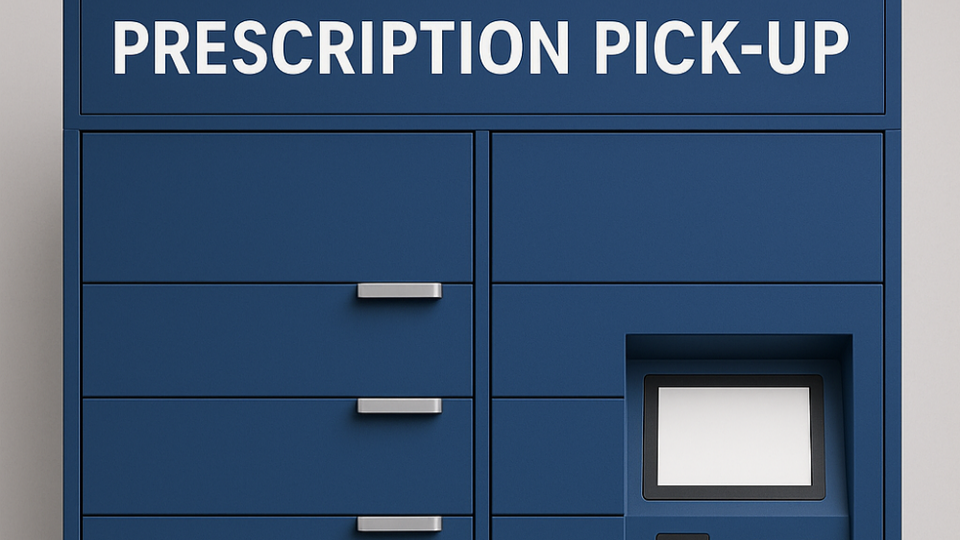
The way prescription pickup lockers work isn't much different than how the package pickup lockers being deployed by major online retailers function. After a pharmacist verifies a prescription and packages the medication, it is placed into an individual locker compartment. The system then sends a text message to the customer, letting them know their prescription is ready. This notice may include a pickup code, barcode or QR code that will open the correct locker door.
When the customer arrives, they go directly to the locker instead of the pharmacy counter and enter or scan their code on the locker screen. The system verifies the information and automatically unlocks the correct compartment.
The patient retrieves their medication and closes the door, which resets the locker for the next prescription. Most systems are available whenever the store is open, allowing for pickup outside normal pharmacy hours.
In many cases, the locker software integrates with the pharmacy's internal systems so staff can track which prescriptions are loaded, picked up or still waiting. Pharmacists can monitor inventory, receive alerts if a prescription is not collected, and reassign the locker slot if needed.
Benefits on both sides of the counter
The benefits of prescription pickup lockers for both pharmacy and patient are readily apparent.
For the pharmacy, the lockers offer many of the same benefits as self-service devices in restaurants, retail outlets or grocery stores. At their core, they automate mundane tasks, freeing staff up to spend more time deli
"Lockers automate the simplest part of the transaction, the handoff," said Jane Moon, pharmacist and director at supplement provider Herba Health Inc. Moon has more than a decade of experience in specialty pharmacy, community practice, and patient access services in Canada.
Those lockers free up pharmacy technicians and pharmacists from spending time on routine pickups, Moon said, allowing them to focus their attention on complex patient counseling, medication reconciliation, and other clinical services that require their expertise.
"From a staffing perspective, it provides staffing relief not by cutting jobs, but by reallocating labor to where it matters most: the consultation counter," Moon said. "It also makes inventory management easier by creating a secure, clearly tracked holding area for ready-to-go prescriptions."
For patients, the main benefit is simple: time and access.
"We have a society that runs on tight schedules and being able to pick up a needed medication at midnight, or on a Sunday when the pharmacy is closed, eliminates a major headache," Moon said. "This convenience can directly translate to better adherence, meaning patients are more likely to stay on schedule with their necessary treatments because the barrier of a pharmacy's operating hours is gone."
For pharmacies, the benefit is twofold: efficiency and focus. Pharmacists and technicians can focus their attention on complex patient counseling, medication reconciliation, and other clinical services that require their expertise.
The lockers also help reduce congestion in the pharmacy waiting area thanks to the ability to provide faster service. An extreme example is presented in a 2024 study published in the Journal of Biomedical Engineering and Medical Imaging, which describes the deployment of pickup lockers in Africa. The study cites examples of clinic waits of roughly 3 to 4 hours being cut to a few minutes thanks to pickup lockers.
Some challenges remain
With every transformational solution, of course, there are issues that need to be addressed. One of the most prominent is the legality of the lockers themselves, with rules varying by state.
Some states have now explicitly authorized and regulated them, while others treat them under broader "automated storage and delivery system" rules. Connecticut, for example, allows their use only if pharmacies submit protocols that meet specified requirements. North Carolina allows ScriptCenter prescription-locker systems supplied by solution provider Asteres to be used in pharmacies and remote pharmacies with a limited-service permit.
Asteres has deployed more than 1,000 ScriptCenter units installed in healthcare facilities and retail pharmacies in 38 U.S. states.
"Expanding options for patients to securely pick up medications at a time and location that's convenient for them, increases access to prescriptions and ultimately improves healthcare for pharmacy patients," said Asteres President and CEO David J. Lenny in a release announcing the approval. "ScriptCenter provides another tool in a pharmacy's toolbox to offer exceptional service to patients by reducing lines, expanding hours, and freeing up pharmacy staff to spend time with patients who need it most."
Another concern is whether a prescription pickup locker deployed in a location other than a pharmacy counts as a separate pharmacy, requiring a permitting process similar to that required for a new brick-and-mortar operation.
And stricter rules come into play if the locker is dispensing opioids or other controlled substances. In Kentucky, for example, regulations require mechanisms to be in place for securing medications and accounting for all removals and returns from automated devices. Similar rules are on the books in other states.
Other concerns revolved around payment for prescriptions. The sales team at Southwest Solutions Group, a Lewisville, Texas-based solution provider, recommends collecting payment at the time of order, rather than at the locker, to avoid integration hassles.
Additionally, what if the medicine being dispensed requires refrigeration while awaiting pickup? Should the pharmacy invest in lockers that include refrigeration capabilities, or reserve those medicines for counter pickup only?
As pharmacies continue to grapple with staffing shortages, expanding clinical responsibilities, and rising customer expectations, prescription pickup lockers provide a practical solution. They do not replace the pharmacist's expertise; rather, they create breathing room for it.
Although regulatory questions and implementation details still need to be ironed out, pharmacies seeking to improve efficiency, boost adherence and enhance customer satisfaction are increasingly viewing lockers not as a novelty but as a strategic investment.
Related Media
Subscribe
Get the latest news and resources from Vending Times.